21 May Pu-erh Tea and Digestion: Why Chinese Medicine Has Used It for Centuries
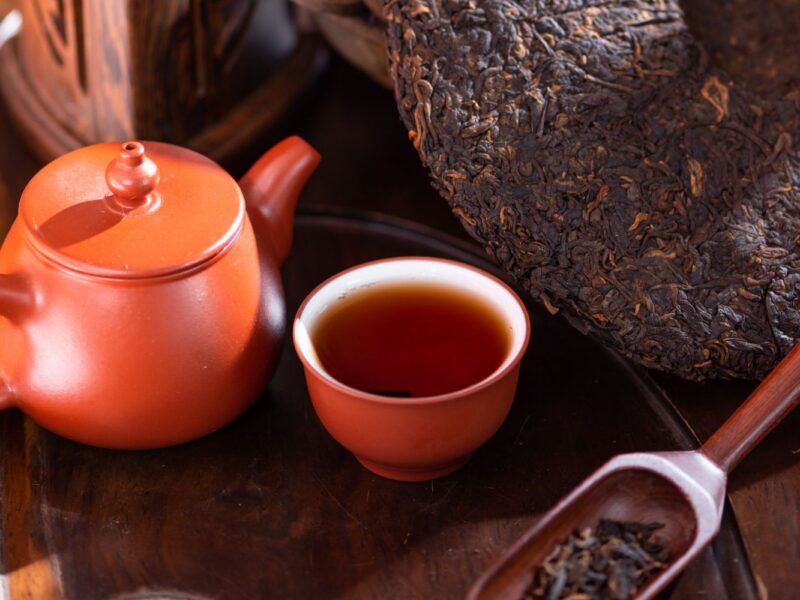
If you have ever finished a rich meal and wished for something to help your body settle, you are reaching for exactly what millions of people in China have reached for across centuries – a bowl of pu-erh tea. Long before the language of gut microbiomes and digestive enzymes existed, practitioners of Traditional Chinese Medicine (TCM) understood something profound about this deeply fermented tea: it works.
Pu-erh tea and digestion have been linked in Chinese medicine for well over a thousand years. Today, modern science is beginning to confirm what those ancient practitioners observed through careful, patient study.
In this guide, we explore why pu-erh is so uniquely powerful for gut health, how it is used in TCM, and what research is now revealing about its extraordinary benefits.
At Teapro, we source pure, single-origin pu-erh with no artificial flavourings – because the real thing, made properly, does not need any enhancement. You can explore our complete pu-erh tea guide for everything you need to know about sourcing, tasting, and understanding this remarkable tea.
In this guide
What Makes Pu-erh Tea Different – Fermentation and Time
Pu-erh in Traditional Chinese Medicine – A Thousand-Year Relationship
What Modern Science Says About Pu-erh Tea and Digestion
Why Pure Pu-erh Matters – What Artificial Flavourings Cannot Replicate
How to Brew Pu-erh Tea for Maximum Digestive Benefit
Who Should Consider Pu-erh Tea for Gut Health
What to Taste For – Learning the Pu-erh Palate
Frequently asked questions
Ready to Go Deeper with Pu-erh?
What Makes Pu-erh Tea Different – Fermentation and Time
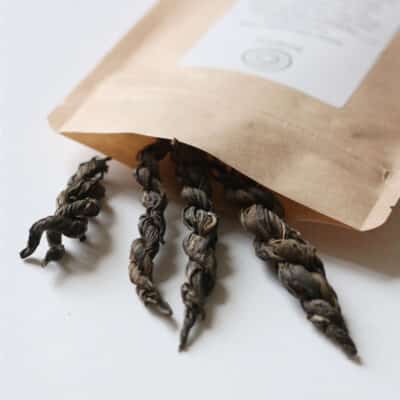
Pu-erh is unlike any other tea in the world. While green, white, and oolong teas are processed to stop oxidation and preserve freshness, pu-erh goes through a controlled microbial fermentation process – sometimes for years, sometimes for decades.
This is not a flaw or an accident. It is the point.
There are two main categories:
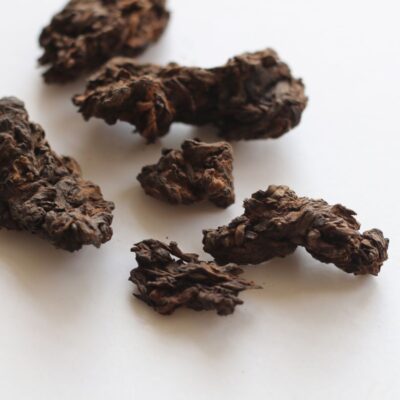
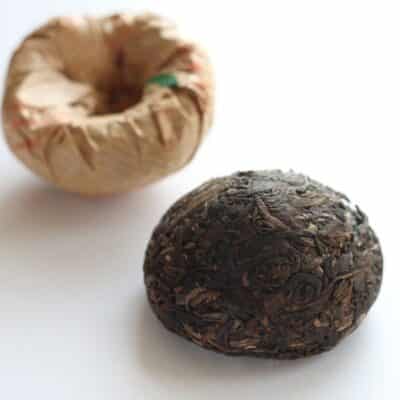
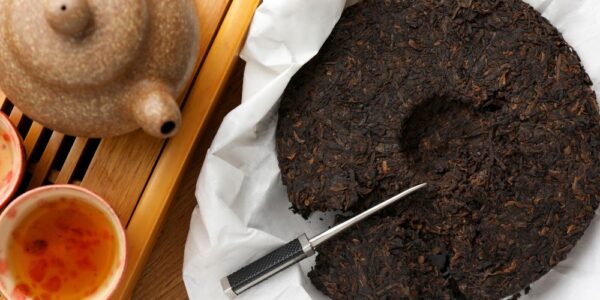
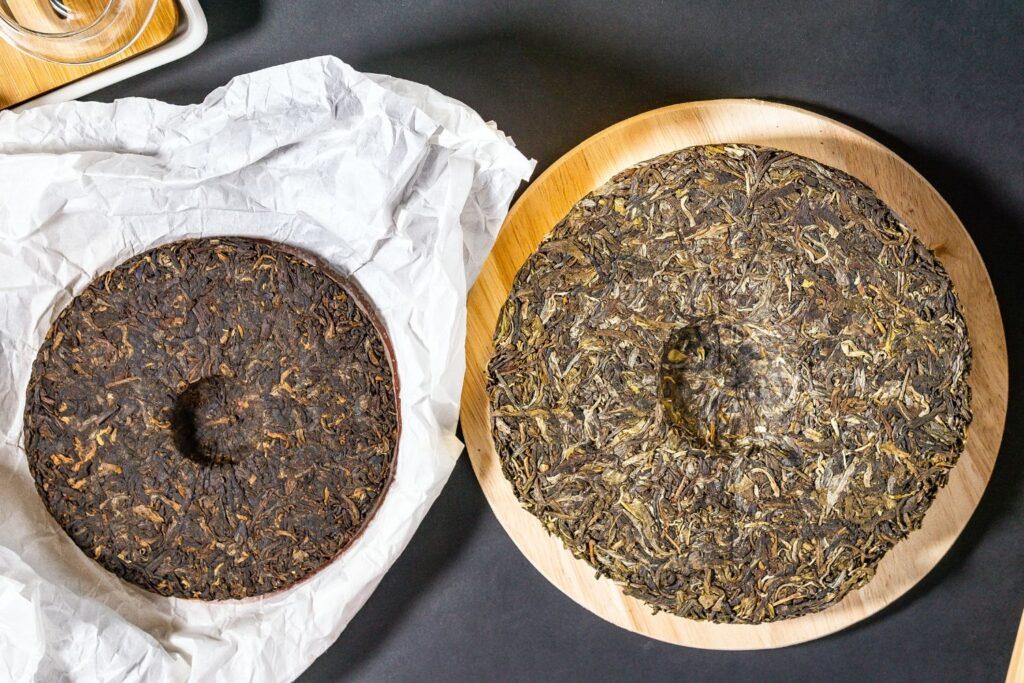
Raw pu-erh (sheng): Pressed into cakes and aged naturally, sometimes for 10, 20, or even 50+ years. The flavour and chemical composition transform dramatically over time.
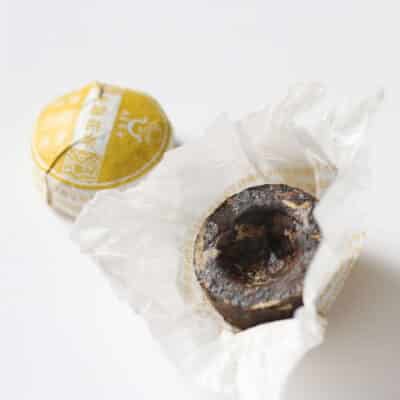
Ripe pu-erh (shou): Developed in the 1970s using an accelerated wet-piling process (wo dui) that mimics decades of natural ageing in a matter of months. Earthy, smooth, and deeply grounding.
This fermentation process transforms the tea at a molecular level – breaking down polyphenols, creating new microbial compounds, and building a profile of beneficial organisms that are quite unlike anything found in other teas.
It is precisely these qualities that made pu-erh a cornerstone of Chinese medicine for digestive health.
Discover the Differences Between Sheng and Shou Pu-erh Tea
Pu-erh in Traditional Chinese Medicine – A Thousand-Year Relationship
In Traditional Chinese Medicine, the digestive system is considered the root of all health. The spleen and stomach, in TCM terms, govern the transformation and transportation of food – turning what we eat into qi (life energy) and distributing it through the body. When digestion is sluggish, the whole system suffers.
Pu-erh has been documented in Chinese medical texts as far back as the Tang Dynasty (618-907 AD), where it was recommended to aid digestion, reduce bloating, and support the functions that TCM attributes to the spleen and stomach.
By the time of the Ming Dynasty (1368-1644), pu-erh was being traded extensively along the Ancient Tea Horse Road – partly because travellers and traders found it essential for digesting the heavy, meat-rich diets common in Tibet and other regions along the route.
The Five Digestive Functions Attributed to Pu-erh in TCM
Traditional Chinese Medicine practitioners have long used pu-erh tea to address five key areas of digestive function:
| Function | What it means |
|---|---|
| Resolving food stagnation (xiaoshi) |
When heavy food sits uneasily in the stomach, pu-erh was prescribed to help the digestive system move it through. This is the original reason it became a staple after fatty, protein-heavy meals. |
| Strengthening the spleen and stomach | In TCM terms, a weak spleen leads to fatigue, poor appetite, and loose stools. Pu-erh was believed to tonify these organs and support their proper function. |
| Clearing heat and dampness | Excessive rich food or alcohol was thought to create internal heat and dampness - a TCM description of inflammation and stagnation in the gut. Pu-erh was considered cooling and clarifying in this regard. |
| Reducing grease and fat (quyouni) |
This function was observed empirically long before anyone understood lipid metabolism - TCM practitioners noted that pu-erh seemed to counteract the heaviness of fatty foods. As we will see, modern science has a clear explanation for this. |
| Calming the digestive system | Pu-erh was also used to soothe an agitated or uncomfortable gut, reducing bloating and cramping after meals. |
What Modern Science Says About Pu-erh Tea and Digestion
In recent decades, researchers have turned their attention to pu-erh and its effects on the body with genuinely exciting results. The ancient claims are holding up.
Pu-erh and the Gut Microbiome
The fermentation process that defines pu-erh produces a unique community of microorganisms – including beneficial bacteria and fungi that survive brewing and reach the gut.
Studies have found that pu-erh consumption can positively shift the composition of the gut microbiome, increasing populations of beneficial bacteria while reducing harmful ones. This microbiome support directly underpins the digestive benefits that TCM practitioners observed for centuries.
Pu-erh and Fat Digestion
Research has shown that pu-erh tea inhibits the activity of pancreatic lipase – the enzyme responsible for breaking down dietary fats in the small intestine.
This means less fat is absorbed after meals, which aligns precisely with the ancient TCM observation that pu-erh helps reduce the heaviness of greasy, fatty food. This is not metaphor. The chemistry matches the centuries-old clinical observation.
Pu-erh and Digestive Enzyme Activity
The polyphenols in pu-erh – particularly theabrownins, a group of compounds formed during fermentation – have been shown to modulate digestive enzyme activity and support the movement of food through the gut.
Studies in both animal models and human trials have linked regular pu-erh consumption to improved digestive transit and reduced incidence of bloating.
Pu-erh and Cholesterol Levels
Multiple studies have found that pu-erh consumption is associated with reduced LDL (bad) cholesterol and triglycerides, with some studies suggesting improvement in HDL (good) cholesterol levels.
These effects connect directly to the digestive pathway – pu-erh appears to alter how the gut processes and absorbs lipids, which translates to measurable changes in blood lipid profiles over time.
Why Pure Pu-erh Matters – What Artificial Flavourings Cannot Replicate
This is where quality becomes non-negotiable. The digestive benefits of pu-erh tea depend on the living microbial community and unique fermentation compounds that develop over time in properly processed leaves.
Artificial flavourings added to cheap tea blends do not replicate these compounds. They mask an inferior product – and they deliver none of the gut health benefits that make real pu-erh extraordinary.
At Teapro, we believe the leaf should speak for itself. Our single-origin pu-erh carries the authentic earthy, rich, and deeply complex flavour that comes from proper fermentation and careful sourcing – not from flavouring. When you taste the real thing, you understand immediately why it cannot be faked.
To understand how to identify and appreciate genuine pu-erh – including what to look for on the label, what different ages and origins taste like, and how to brew it correctly – visit our complete pu-erh tea guide.
How to Brew Pu-erh Tea for Maximum Digestive Benefit
To get the most from pu-erh tea and digestion, the way you brew matters. Here is how to do it properly:
Rinse the leaves first. Pour boiling water over the leaves, swirl briefly, and discard this first infusion after 5-10 seconds. This awakens the leaves and removes any surface dust. Do not skip this step with aged or compressed pu-erh.
Use boiling water (95-100C). Unlike delicate green teas, pu-erh is robust and benefits from high-temperature water, which fully extracts its unique compounds.
Brew for 2-3 minutes for loose leaf, longer for compressed. Adjust to your taste. Ripe pu-erh is forgiving – it rarely turns bitter even with longer steeping.
Drink after meals. In both TCM practice and modern usage, pu-erh is most beneficial when consumed 30-60 minutes after a meal – particularly a rich or heavy one. This is when it can most effectively support fat digestion and gut movement.
Re-steep your leaves. Quality pu-erh is built for multiple infusions. Many serious pu-erh drinkers find the second and third brews even more enjoyable than the first.
Discover the art of brewing pu-erh tea, from selecting the leaves to savoring its rich, earthy flavor. This guide will help you enjoy every cup to its fullest.
Who Should Consider Pu-erh Tea for Gut Health
Pu-erh is particularly well-suited to:
People who experience bloating or heaviness after meals. If rich food consistently leaves you feeling sluggish or uncomfortable, the post-meal pu-erh habit is worth building.
Those moving away from coffee. Pu-erh contains caffeine – typically less than coffee – but its effect is distinctly different. Many people describe a smoother, calmer energy without the sharp spike and crash, and without the acidity that can aggravate the gut.
Anyone building a daily wellness ritual. Because pu-erh benefits accumulate with regular consumption, it rewards consistency. Making it part of your daily routine – particularly around meals – is how you experience its full range of digestive benefits.
Tea enthusiasts who want to go deeper. Pu-erh is one of the most complex and fascinating teas in the world. Its depth of flavour, its connection to place and time, and its extraordinary ageing potential make it a subject of genuine lifelong study.
What to Taste For – Learning the Pu-erh Palate
One of the great joys of drinking pu-erh is learning to read what your palate is telling you. Here is what to pay attention to:
Earthiness: Good pu-erh has a deep, forest-floor earthiness that is clean and pleasant – not musty or damp. If it smells unclean, that is a quality issue.
Smoothness: Well-aged or well-processed pu-erh should be silky and smooth in the mouth with no harsh bitterness or astringency.
Hui gan: This is the returning sweetness – a pleasant, gentle sweetness that emerges in the back of the throat after swallowing. Tea drinkers consider this one of the most prized qualities in a high-quality pu-erh.
Warmth in the body: Many experienced pu-erh drinkers notice a spreading warmth and sense of settling in the stomach – the sensation that Chinese medicine practitioners described as the tea working on the digestive system.
Frequently asked questions
Pu-erh tea is unique because it undergoes a controlled microbial fermentation process – sometimes for years or even decades – rather than being processed to stop oxidation like green, white, or oolong teas. This fermentation transforms the tea at a molecular level, creating beneficial microbial compounds not found in any other tea. There are two main types: raw (sheng), which is aged naturally, and ripe (shou), which uses an accelerated wet-piling process developed in the 1970s.
Pu-erh tea has been used to support digestion for well over a thousand years. It was documented in Chinese medical texts as far back as the Tang Dynasty (618–907 AD), where it was recommended to aid digestion and reduce bloating. By the Ming Dynasty (1368–1644), it was being traded along the Ancient Tea Horse Road, valued by travellers for helping digest the heavy, meat-rich diets common in Tibet and surrounding regions.
In Traditional Chinese Medicine (TCM), pu-erh is used to address five key digestive functions: resolving food stagnation (xiao shi) to help the body process heavy meals; strengthening the spleen and stomach; clearing internal heat and dampness caused by rich food or alcohol; reducing the heaviness of greasy and fatty foods (qu you ni); and calming an agitated gut to reduce bloating and cramping.
Yes. Research has shown that pu-erh positively shifts gut microbiome composition, increasing beneficial bacteria and reducing harmful ones. Studies have also found that pu-erh inhibits pancreatic lipase — the enzyme responsible for breaking down dietary fats — meaning less fat is absorbed after meals. The fermentation-derived compounds called theabrownins have been linked to improved digestive transit and reduced bloating in both animal and human studies.
Multiple studies have associated regular pu-erh consumption with reduced LDL (bad) cholesterol and triglycerides, and some studies suggest improvements in HDL (good) cholesterol. These effects appear to be connected to how pu-erh alters the way the gut processes and absorbs lipids, translating to measurable changes in blood lipid profiles over time.
The optimal time to drink pu-erh for digestive benefit is 30–60 minutes after a meal — particularly a rich or heavy one. This is when it can most effectively support fat digestion and encourage gut movement. In both traditional TCM practice and modern usage, the post-meal timing is considered key to experiencing its full digestive benefits.
Start by rinsing the leaves: pour boiling water over them, swirl briefly, and discard after 5–10 seconds. This awakens the leaves and removes surface dust. Use boiling water (95–100°C) — unlike delicate green teas, pu-erh needs high temperatures to fully extract its compounds. Steep for 2–3 minutes for loose leaf, adjusting to taste. Quality pu-erh holds up to multiple infusions, with many drinkers finding the second and third brews even better than the first.
Yes, pu-erh contains caffeine, but typically less than coffee. Many people describe the energy effect as smoother and calmer — without the sharp spike and crash common with coffee — and without the acidity that can irritate the gut. This makes it a popular choice for those looking to reduce their coffee intake while maintaining a gentle energy boost.
The digestive benefits of pu-erh depend on its living microbial community and unique fermentation compounds, which only develop through proper processing and time. Artificial flavourings added to cheaper tea blends do not replicate these compounds. They mask an inferior product and deliver none of the gut health benefits associated with authentic, properly fermented pu-erh. Single-origin, unflavoured pu-erh is essential if you want the real thing.
High-quality pu-erh should have a deep, clean earthiness — think forest floor, not mustiness. It should feel silky and smooth with no harsh bitterness or astringency. Look for hui gan, the returning sweetness that emerges at the back of the throat after swallowing — this is considered one of the most prized qualities in fine pu-erh. Many experienced drinkers also notice a spreading warmth and sense of settling in the stomach after drinking.
Pu-erh is particularly well-suited to people who regularly experience bloating or heaviness after meals; those looking to transition away from coffee; anyone building a daily wellness ritual around gut health; and tea enthusiasts interested in one of the world’s most complex and historically significant teas. Because its benefits accumulate over time, consistency is key — making it a regular part of your mealtime routine delivers the best results.
Ready to Go Deeper with Pu-erh?
Understanding pu-erh tea and digestion is just the beginning. This is a tea type with centuries of history, extraordinary regional variation, and a depth of character that rewards serious study. Our complete pu-erh tea guide covers everything from how to choose between raw and ripe pu-erh, to how ageing affects flavour, to the regions of Yunnan province where the finest leaves are grown.
At Teapro, we exist to turn tea drinkers into tea pros – and pu-erh is one of the most rewarding teas to understand deeply. Every purchase from Teapro comes with the knowledge to make it meaningful: where it comes from, how to brew it, and what to taste for.
The leaf has a story to tell. Let it speak.

Teapro co-founder. Favourite tea - Long Jing Dragon Well Green Tea. Obsessed with film, photography and travelling.


No Comments