21 May Pu-erh Tea Cakes: What Are They and How Do You Use One?
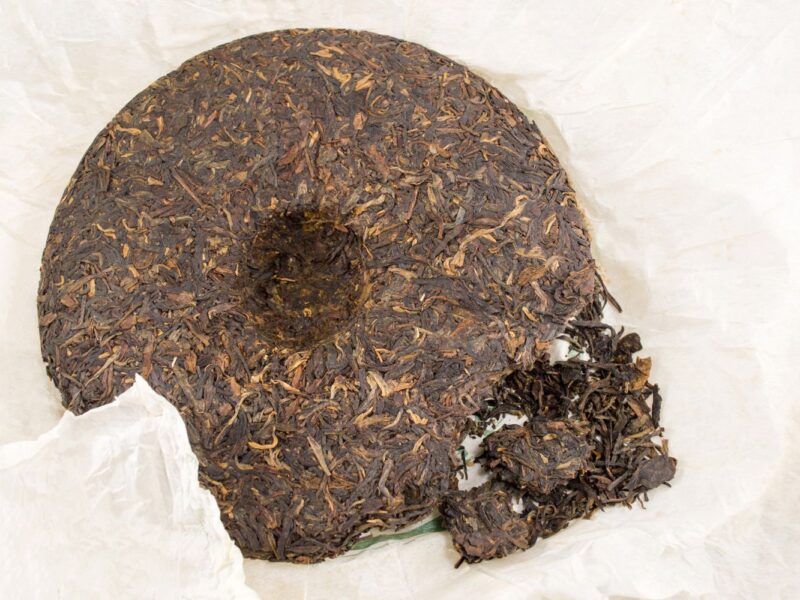
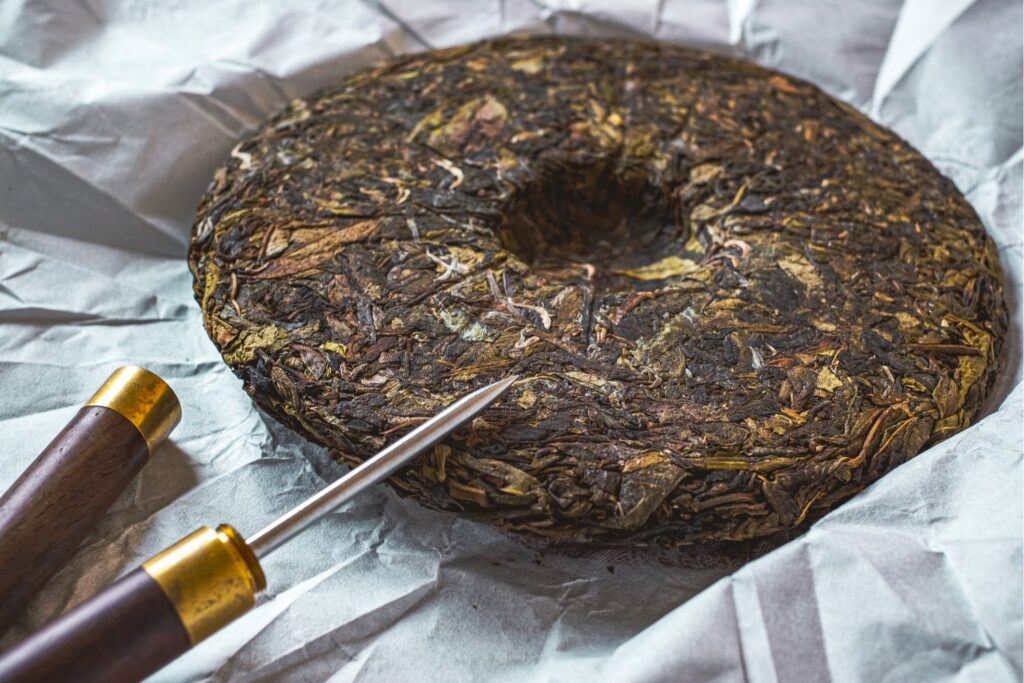
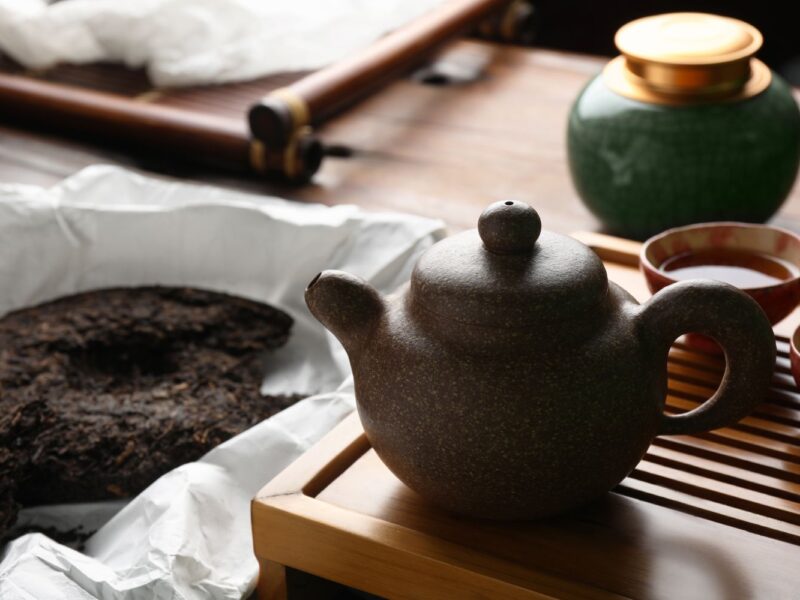
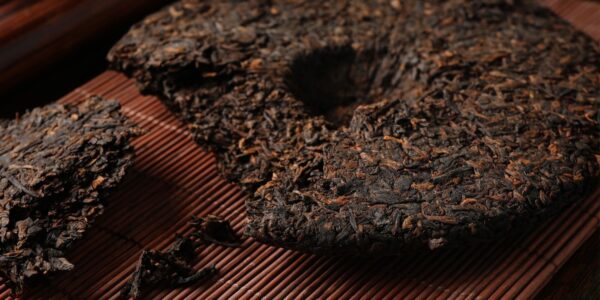
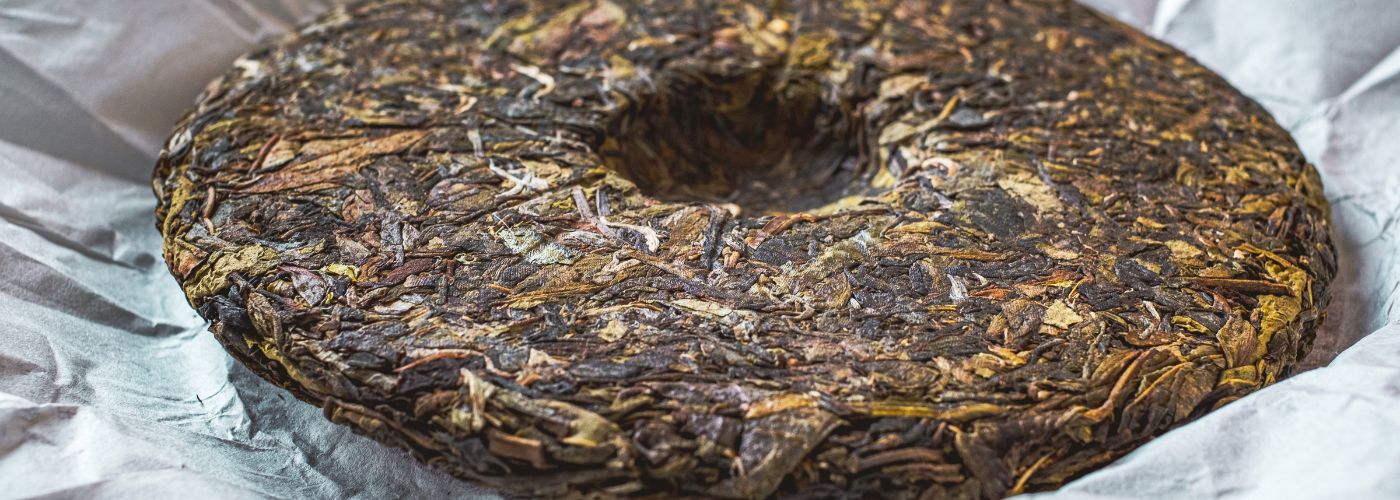
Pick up a pu-erh tea cake for the first time and it is hard to know what you are holding. It is solid. It is heavy. It looks more like a disc of compressed earth than something you would put in a teapot. And yet inside that tightly pressed form is one of the most complex, age-worthy and genuinely fascinating teas in the world.
Pu-erh tea cakes have been made for over a thousand years. They were originally pressed into this shape for practical reasons – compressed tea travels better, stores better and ages better than loose leaf.
Today, serious collectors age pu-erh cakes the way others age wine: for decades, in carefully controlled conditions, watching the flavour evolve over time.
But you do not need to be a collector or a connoisseur to enjoy a pu-erh tea cake. You need to know what it is, how to break it apart without destroying it, and how to brew it correctly. This guide covers all of that.
If you want the full background on pu-erh tea first – what it is, how it is processed, and the difference between sheng and shou – our complete guide to pu-erh tea is the place to start. Come back here when you are ready to work with the cake itself.
Table of contents
What is a pu-erh tea cake?
Sheng versus shou: which type of cake are you buying?
How to read a pu-erh cake wrapper
How to break apart a pu-erh tea cake
How to brew a pu-erh tea cake: step by step
What pu-erh tea cake tastes like across multiple steep
Storing your pu-erh tea cake
Quick-reference guide for pu-erh tea cakes
Frequently asked questions about pu-erh tea cakes
What is a pu-erh tea cake?
A pu-erh tea cake – also called a bing cha, which translates roughly as cake tea – is pu-erh tea that has been steamed and then compressed into a flat, disc-like shape. The standard weight is 357g, though cakes also come in 250g, 400g and other sizes depending on the producer and the region.
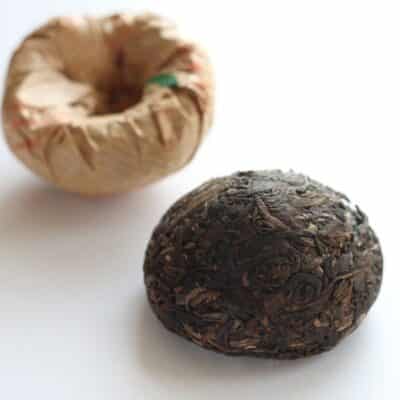
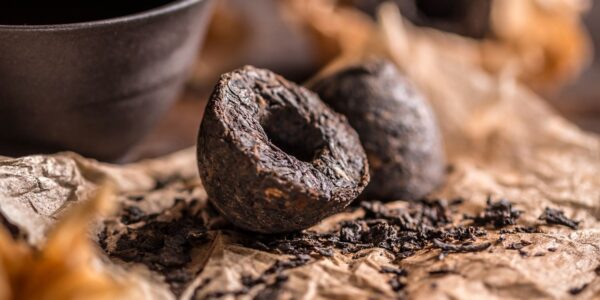
The disc shape is the most common, but pu-erh is also pressed into other forms: bricks (fang cha), mushroom shapes (tuo cha), and small individual portions called mini-tuos. The brewing principles are the same regardless of shape.
What varies is how you break them apart and how quickly they age – the shape affects airflow around the leaves, which affects how the tea develops over time.
Why press tea into a cake at all?
The original reason was practical. Compressed tea is easier to transport than loose leaf – it is denser, more stable and less prone to damage on long journeys.
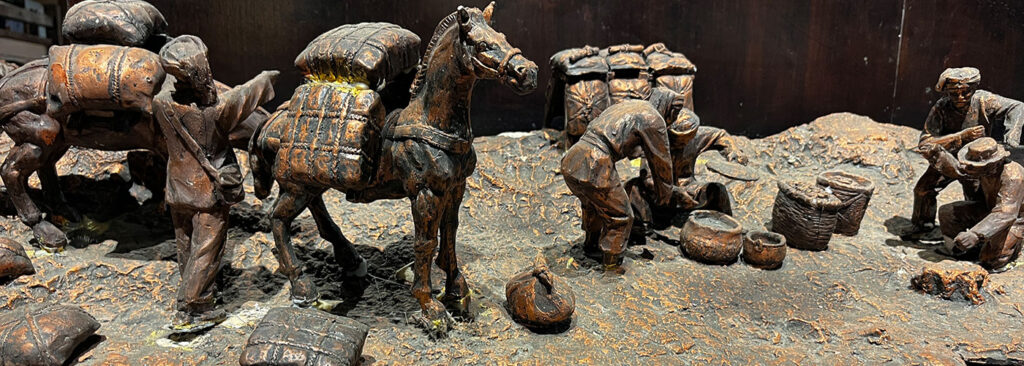
The ancient Tea Horse Road, along which pu-erh travelled from Yunnan Province into Tibet and beyond, could take months to traverse. Compression made the journey manageable.
The second reason is ageing. Compressed pu-erh ages differently – and many would say better – than loose leaf pu-erh. The density of the cake slows oxidation, allowing the flavour to develop gradually over years or decades rather than rapidly.
The outer layers of the cake age slightly faster than the inner layers, which creates complexity within a single cake as you work through it over time.
The third reason is value. A well-stored, well-aged pu-erh cake from a reputable producer appreciates in value over time. This is unusual for any food or drink, and it is one of the reasons pu-erh has attracted such serious collector interest.
Sheng versus shou: which type of cake are you buying?
Before you can use a pu-erh cake correctly, you need to know which type you have. The two main categories of pu-erh – sheng (raw) and shou (ripe) – behave quite differently in the cup, and they require slightly different approaches.
Sheng pu-erh (raw)
Sheng pu-erh is the traditional form. After harvesting and initial processing, the leaves are pressed into cakes and then aged – for years, sometimes decades. Young sheng is often quite green, astringent and intensely aromatic.
As it ages, the flavour mellows, deepens and becomes more complex. A well-aged sheng from a good producer is genuinely extraordinary – earthy, woody, smooth, with layers of flavour that unfold across multiple steeps.
Young sheng (under 5 years old) can be quite challenging to drink: astringent, sometimes bitter, with a sharp energy.
It is an acquired taste. Aged sheng (10 years and older) is where most of the serious collector interest lies.
Shou pu-erh (ripe)
Shou pu-erh was developed in the 1970s as a way to produce the earthy, mellow character of aged sheng without waiting decades.
The leaves go through an accelerated fermentation process – wet piling – which produces the characteristic dark colour, smooth body and deep, earthy flavour that shou is known for.
Good shou tastes of dark earth, wood, dried fruit and sometimes dark chocolate.
It is approachable from day one and does not need ageing to be enjoyable.
If you are new to pu-erh tea cakes, shou is the better starting point.
It is consistent, forgiving to brew, and delivers the pu-erh experience without the learning curve of young sheng.
How to read a pu-erh cake wrapper
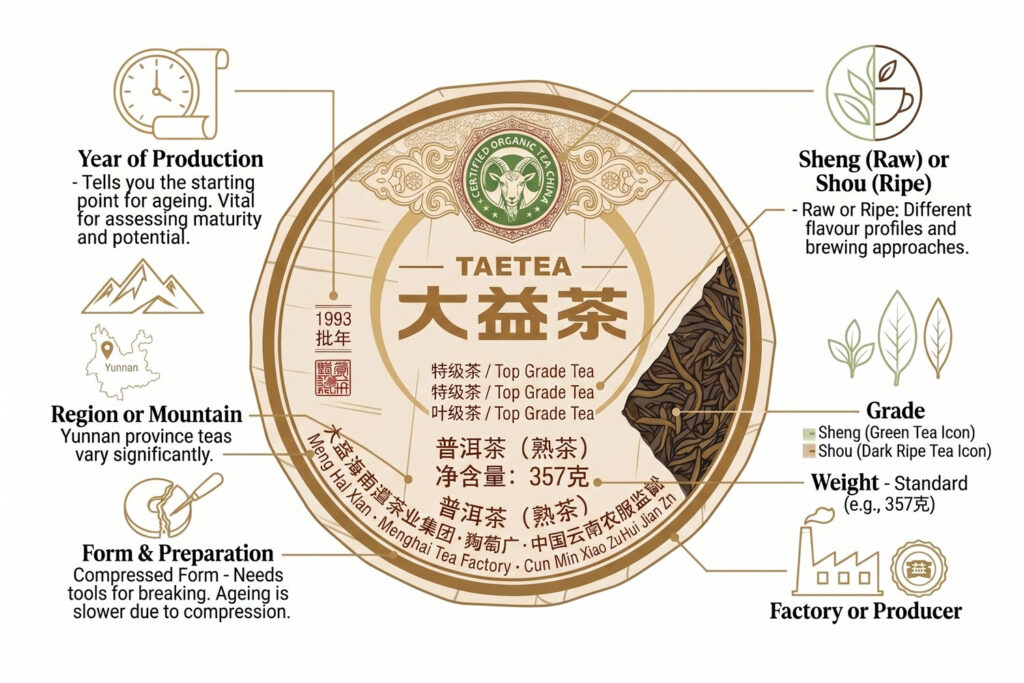
Most pu-erh cakes come wrapped in a single sheet of thin paper, sometimes with a small inner ticket (called a nei fei) pressed directly into the surface of the cake itself. The wrapper typically tells you the producer, the year of production, the region the leaves came from, and whether it is sheng or shou.
Key information to look for:
Year of production – tells you the starting point for ageing
Sheng or shou – raw or ripe; different flavour profiles and brewing approaches
Region or mountain – Yunnan province teas vary significantly by growing area; Yiwu, Bulang, Jingmai and Mengku all produce distinct character
Grade – refers to leaf size and maturity, not quality in the conventional sense
Factory or producer – established producers have consistent processing standards
If the wrapper gives you no useful information, that is itself useful information. Quality pu-erh is traceable. Producers who are proud of their leaves tell you where they came from.
How to break apart a pu-erh tea cake
This is the part most people find intimidating. The cake is hard – sometimes very hard – and it does not want to come apart easily.
The goal is to separate the leaves gently, preserving as many whole or near-whole leaves as possible. Broken and dusty leaf makes for a harsher, less nuanced brew.
What you need
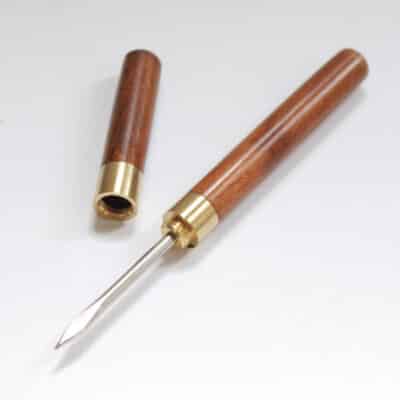
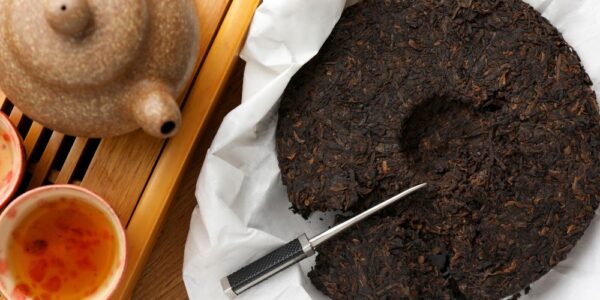
A pu-erh pick (also called a tea needle or pu-erh knife) – the correct tool for the job
A clean, dry surface or a piece of paper to catch the leaves
Patience – this is not a task to rush
The technique
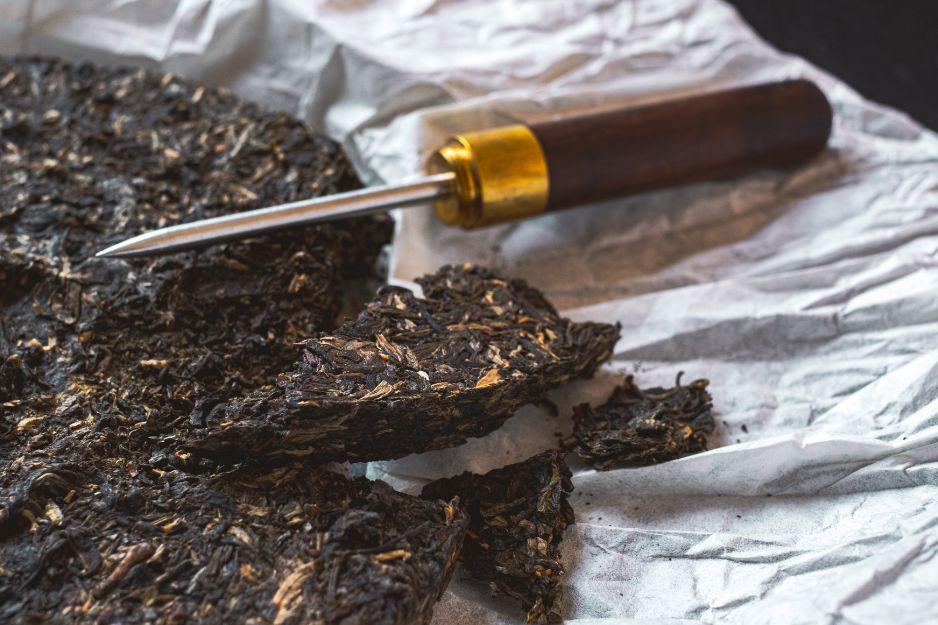
Insert the pick into the side edge of the cake – not the flat face. Work along the natural seams between the compressed layers rather than stabbing straight through. Gently lever and twist rather than forcing. The cake will begin to separate in natural chunks along the compression lines.
Work in sections. Do not try to break off more than you need in one session. Aim for pieces of 5-8g at a time, which is the right quantity for a small gaiwan or teapot session. The rest of the cake stays wrapped and stored.
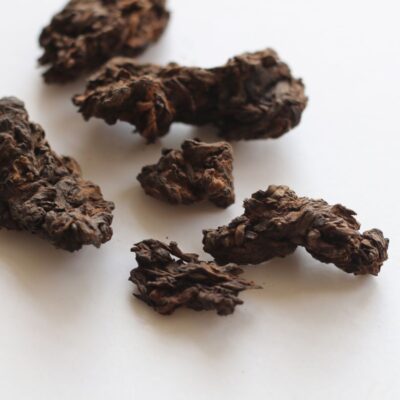
The outer layers of an aged cake will be looser and come away more easily than the dense inner core. The inner layers are more tightly compressed and will require more careful work. Both will brew well – the outer layers may have a slightly more evolved character from greater air exposure.
What not to do
Do not use a knife with a thick blade – it will shatter the leaves rather than prise them apart
Do not apply force from the flat face of the cake – you will crush the leaf
Do not rush – a broken cake can still be brewed, but intact leaves give a better result
How to brew a pu-erh tea cake: step by step
Pu-erh is most traditionally brewed using the gongfu method – small vessels, multiple short steeps, high leaf-to-water ratios. This approach extracts the most from the leaf and allows you to taste how the flavour evolves across each steep.
You can also brew pu-erh in a standard teapot or mug; the results are good, just less nuanced.
Equipment
A gaiwan (100-150ml) or small clay teapot – ideal for gongfu brewing
A standard teapot or mug with infuser – works well for everyday brewing
A kettle – ideally temperature-controlled
A pu-erh pick for breaking off the right amount of leaf
Leaf quantity
Gongfu method: 5-8g per 100ml of water (a high ratio by UK standards)
Western method in a teapot or mug: 3-4g per 250ml
Start at the lower end and adjust to taste – pu-erh is more forgiving than green or white tea
Water temperature
Shou pu-erh: 95-100C – it handles and benefits from near-boiling water
Aged sheng: 90-95C
Young sheng: 85-90C – the lower temperature reduces astringency
The rinse step – do not skip this
Unlike most teas, pu-erh – particularly shou and aged teas – benefits from a rinse before your first drinking steep. Pour boiling water over the leaves, wait 5-10 seconds, then discard the liquid.
This washes the surface of the compressed leaf, opens the leaves slightly, and removes any dust from the breaking process. The rinse also begins warming the leaves evenly, which improves extraction in the steeps that follow.
Some drinkers do two rinses on very aged or heavily compressed cakes. One is usually sufficient.
Steeping time
| Steep | Gongfu method | Western method |
|---|---|---|
| First steep | 10–15 seconds after the rinse | Shou pu-erh: 3–4 minutes |
| Second steep | 15–20 seconds | Aged sheng: 2–3 minutes |
| Third steep | 20–30 seconds | Young sheng: 1.5–2 minutes (shorter to manage astringency) |
| Each subsequent steep | Add 10–15 seconds | — |
| Total steeps | 8–12 steeps before the flavour fades | 2–3 steeps |
The Western method gives you 2-3 good steeps from the same leaves. The gongfu method gives you far more, and the experience of watching the flavour evolve across each steep is part of what makes pu-erh so interesting to drink.
What pu-erh tea cake tastes like across multiple steep
One of the most distinctive things about brewing a pu-erh tea cake using the gongfu method is that the flavour changes significantly from the first steep to the last. This is not a flaw – it is the point.
With a good shou pu-erh, the early steeps tend to be rich, deep and earthy – sometimes with notes of dark wood, dried dates, leather or dark chocolate.
The middle steeps often reveal a smoother, sweeter character. The later steeps become progressively lighter and more delicate, sometimes finishing with a clean sweetness that is quite different from where the session started.
With aged sheng, the evolution is even more pronounced. Early steeps can be complex and slightly astringent. The middle steeps often hit a peak of complexity – layered, mineral, woodsy, sometimes floral or fruity depending on the origin. Late steeps become clean and light.
Paying attention to this evolution is how you develop your palate for pu-erh. Each steep is a different cup.
Storing your pu-erh tea cake
How you store a pu-erh cake matters – both for preserving what you already have and for allowing continued ageing if that is your goal.
Basic storage rule
1. Keep away from strong odours – pu-erh absorbs smells from its environment, which can ruin a cake
2. Avoid direct sunlight and heat – a cool, stable temperature is ideal
3. Maintain some humidity – very dry conditions slow ageing and can make the leaves brittle; very wet conditions encourage mould
4. Allow some airflow – do not seal in an airtight container; the natural wrapper or a breathable paper or cloth bag is ideal
5. Keep away from strongly scented items including other teas, spices and cleaning products
Re-wrapping after opening
Once you have broken into a cake, fold the original paper wrapper back around it as neatly as possible and store it in a cool, dark place.
A dedicated tea storage box, a wooden box with ventilation, or a clay storage jar are all good options. Do not store pu-erh in a plastic bag – it traps moisture and odours.
Ageing at home
If you want to age a pu-erh cake at home, the ideal environment is 60-75% relative humidity, 15-25C, with good air circulation and no competing odours. Basements and wine cellars can work well.
Many serious collectors use dedicated humidors or storage vessels. Even without perfect conditions, a cake stored correctly in a UK home will continue to develop over time.
Quick-reference guide for pu-erh tea cakes
| Topic | Detail |
|---|---|
| Breaking the cake | Use a pu-erh pick, work from the side edge, follow natural seams |
| Quantity — gongfu | 5–8g per 100ml |
| Quantity — Western | 3–4g per 250ml |
| Temperature — shou | 95–100°C |
| Temperature — aged sheng | 90–95°C |
| Temperature — young sheng | 85–90°C |
| Rinse | Always rinse before the first drinking steep (5–10 seconds, discard) |
| Gongfu steeps | Start at 10–15 seconds, add 10–15 seconds each steep |
| Western steeps | 2–4 minutes depending on type |
| Re-steeps | 8–12 for gongfu, 2–3 for Western method |
| Storage | Cool, dark, no airtight seal, away from strong odours |
Frequently asked questions about pu-erh tea cakes
The leaves are the same – the difference is the form. Pu-erh tea cakes are compressed under steam and pressure into a disc shape, which makes them easier to transport, store and age over long periods. Loose pu-erh is simply the same leaf left in its uncompressed state. Compressed cake ages more slowly and often more consistently than loose leaf, which is why serious collectors prefer the cake format for long-term ageing.
For a standard Western-style brew in a teapot or mug, use 3-4g per 250ml of water. For the traditional gongfu method with a small gaiwan or clay teapot, use 5-8g per 100ml. Both methods will give you multiple steeps from the same leaves. Break off what you need with a pu-erh pick and store the rest of the cake wrapped in its paper.
The one tool you genuinely need is a pu-erh pick – sometimes called a tea needle or pu-erh knife – to break the cake apart without crushing the leaves. For brewing, a small gaiwan is traditional and ideal, but a standard teapot or mug with an infuser works perfectly well. A temperature-controlled kettle is useful but not essential.
The rinse – sometimes called the awakening steep – serves several purposes. It cleans the surface of compressed leaves, removing any dust or debris from the breaking process. It opens and hydrates the tightly compressed leaves so they extract more evenly from the first proper steep. And for aged teas, it removes any stale surface notes that have developed during storage. Always discard the rinse water; it is not for drinking.
Properly stored, a pu-erh tea cake does not expire in the conventional sense. Sheng pu-erh continues to age and develop for decades. Shou pu-erh is stable for many years and some would argue continues to improve for 10-20 years with correct storage. The key is keeping it away from strong odours, excessive moisture, direct sunlight and airtight conditions. A cake you bought today could still be excellent in 30 years.
Yes – if stored in conditions that are too humid or without sufficient airflow, mould can develop on the surface of a pu-erh cake. Some surface mould on aged teas is considered acceptable by experienced collectors and can be removed by airing the cake. However, mould that penetrates deep into the cake or produces a sharp, unpleasant smell is a sign of poor storage conditions. When in doubt, do not drink it.
Shou pu-erh has a smooth, deep, earthy character – often described as dark wood, dried fruit, leather or dark chocolate. It is quite different from any other tea and requires some adjustment if you are used to green or black tea. Young sheng is more challenging: astringent, intensely aromatic, sometimes quite bitter. Aged sheng is considered extraordinary by those who love it – complex, mineral, layered. Whether pu-erh is for you depends on whether you enjoy earthy, complex flavour. It is an acquired taste, but one that rewards the effort significantly.
Pu-erh has attracted research interest for its potential effects on digestion, cholesterol and gut health, largely due to the microbial activity involved in the fermentation process. The evidence is still developing, and we are careful not to make health claims that go beyond what the science currently supports. What is clear is that pu-erh is a natural, pure tea with a long history of use as a digestive aid. Our complete guide to pu-erh tea covers the research in more detail.
Look for clear origin information on the wrapper – producer, region, year and type. Good pu-erh is traceable. The leaves inside the cake should be visible and intact, not a uniform dust. When you break the cake, the interior should smell earthy, clean and complex – not musty, sharp or chemical. A reputable supplier will be transparent about what they are selling and where it came from. If the provenance is vague, the quality probably is too.
Want to go deeper on everything pu-erh – how it is processed, the difference between sheng and shou, the major growing regions, and what to look for when buying? Our complete guide to pu-erh tea covers the full picture from leaf to cup.
Pu-erh tea cakes reward the curious. The more you understand about what you are holding, the more you taste in every steep. That is the Teapro way – we do not just sell you the tea, we give you the knowledge to understand it. That is how you go from tea drinker to tea pro.

Teapro co-founder. Favourite tea - Long Jing Dragon Well Green Tea. Obsessed with film, photography and travelling.


No Comments