09 May What Is Flowering Tea? The Complete Guide
Hand-tied, hand-sewn and designed to bloom in the cup – the story, the craft and the truth about one of tea’s most extraordinary art forms.
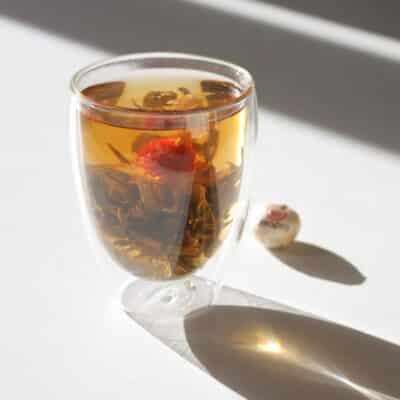
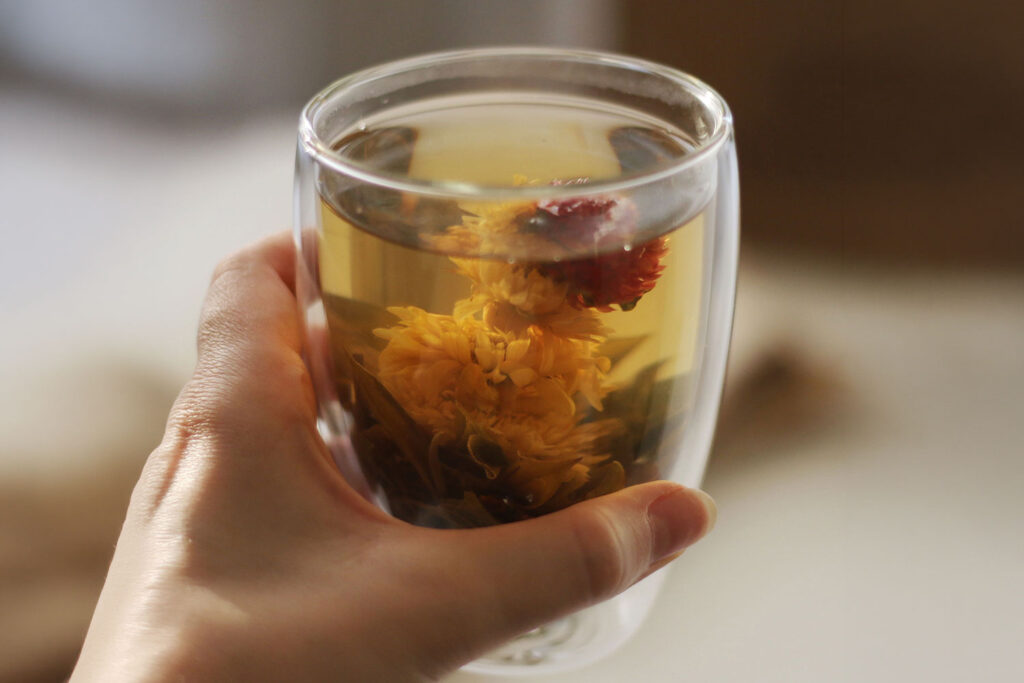
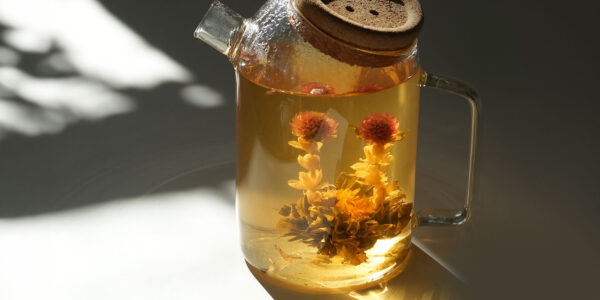
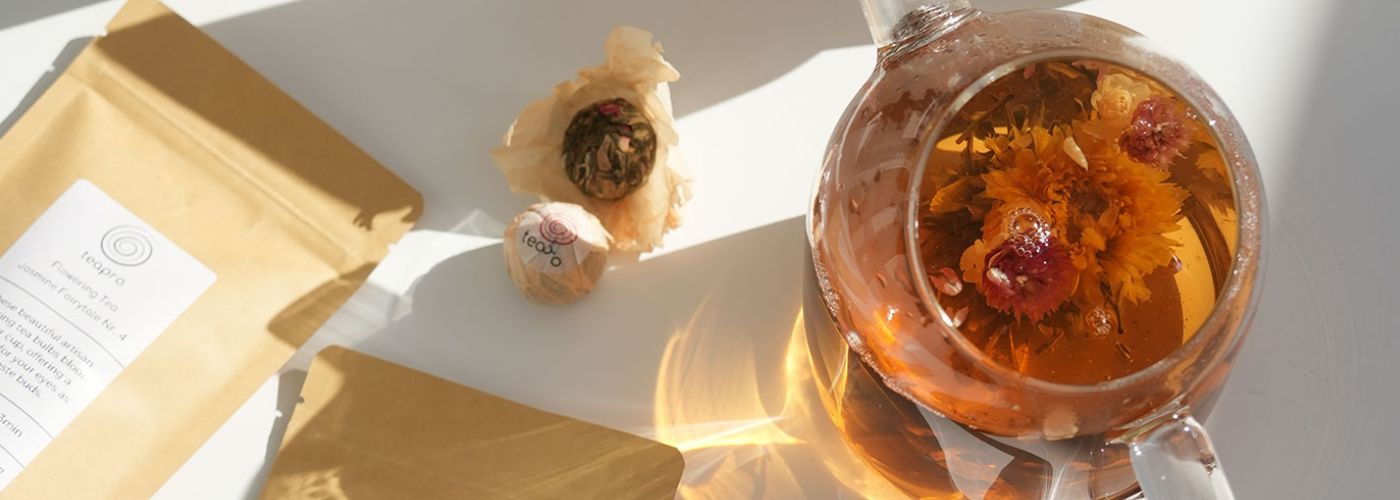
Flowering tea is the point where tea stops being just a drink and becomes something else entirely – a living thing, opening in the cup before your eyes. A single hand-tied tea bud, dropped into a glass teapot, slowly unfurling over several minutes to reveal a flower suspended in water. It is one of the most extraordinary things you can do with tea leaves.
Contents
1. What is flowering tea?
2. How is flowering tea made?
3. The flowers used – and what they mean
4. Types of flowering tea
5. What does flowering tea taste like?
6. Health benefits
7. Caffeine content
8. How to brew flowering tea properly
9. Flowering tea as a gift
10. How to buy flowering tea well
11. Frequently asked questions
12. About Teapro
What is flowering tea?
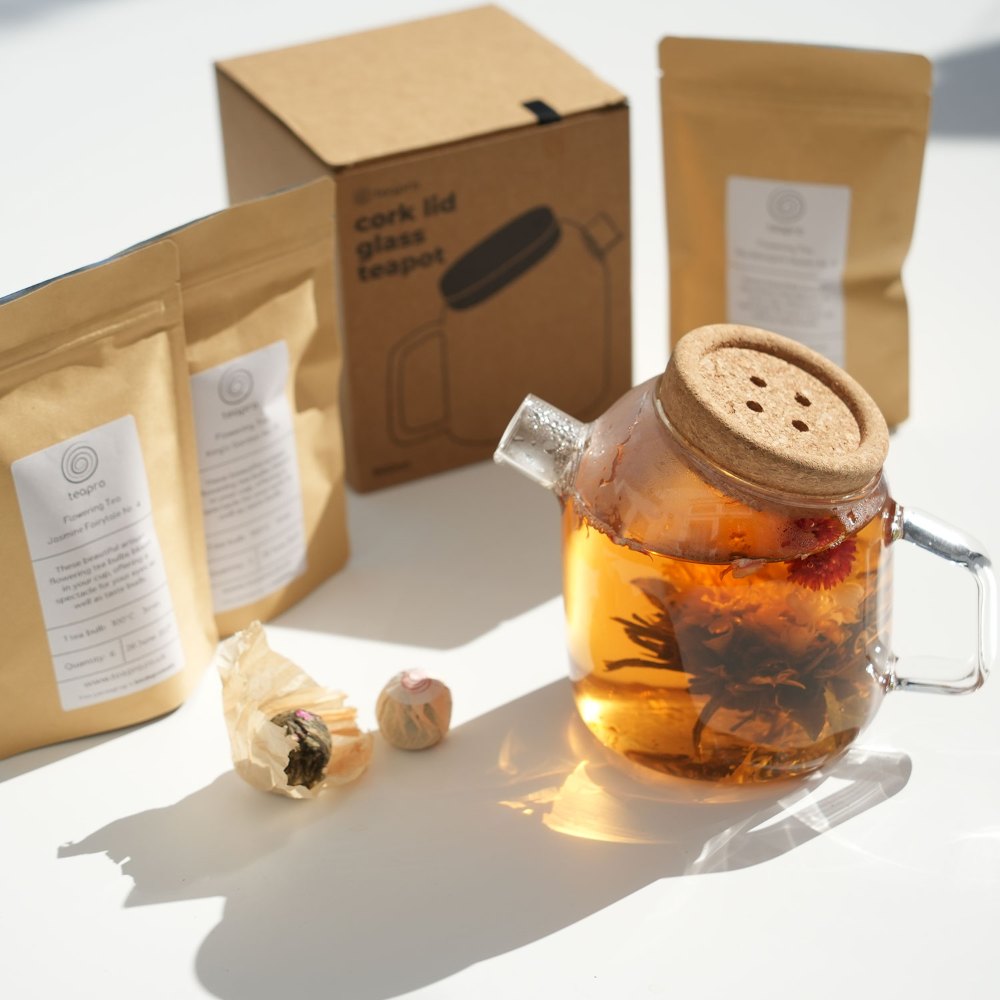
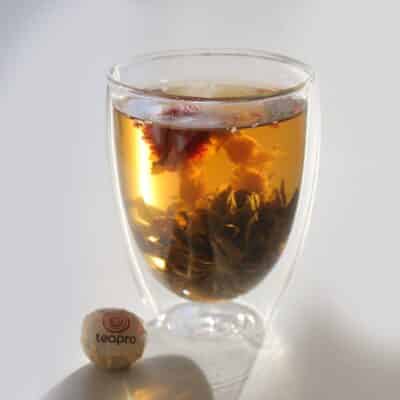
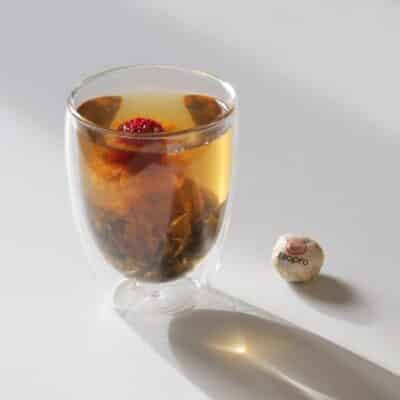
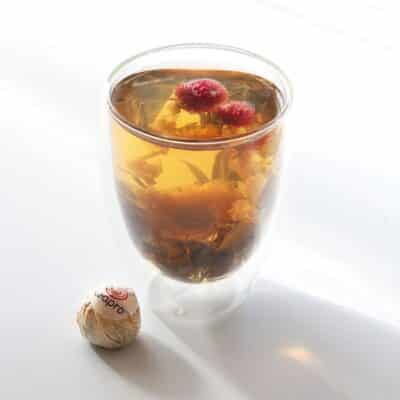
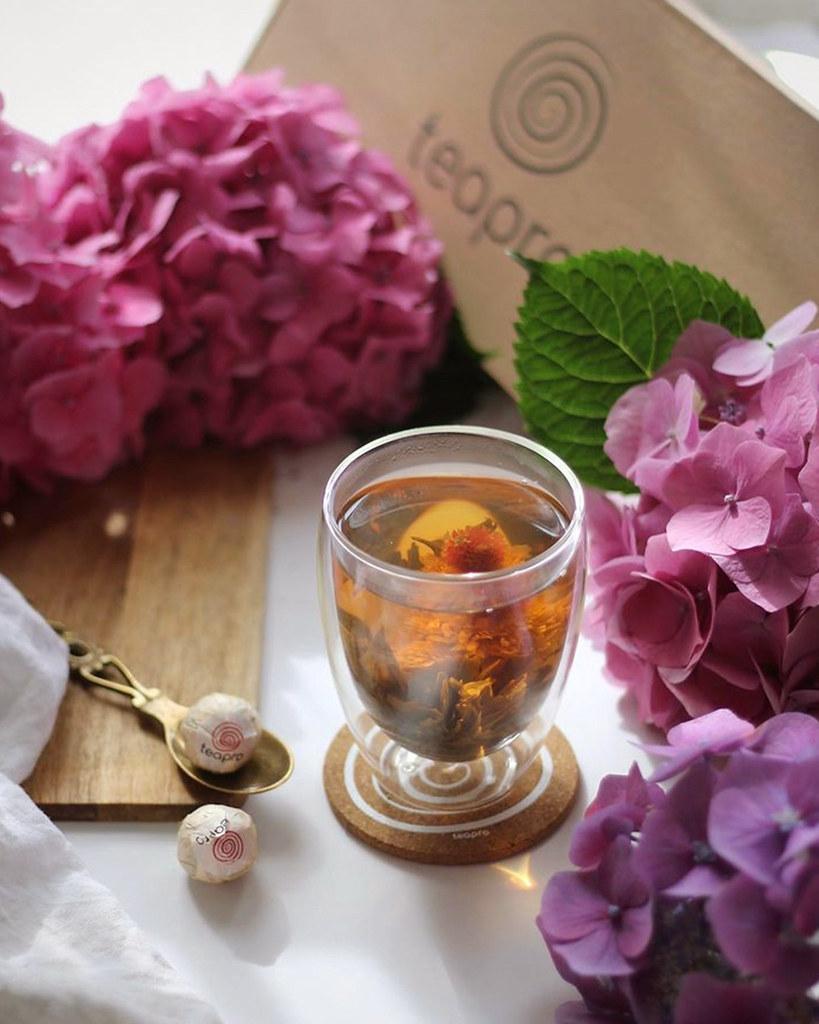
Flowering tea – also called blooming tea or display tea – is a type of tea hand-crafted from real tea leaves and dried flowers, sewn or tied together into a compact bundle or ball. When placed in hot water, the bundle slowly opens over several minutes, the tea leaves expanding outward to reveal the dried flower hidden inside. The result is a living sculpture in the cup.
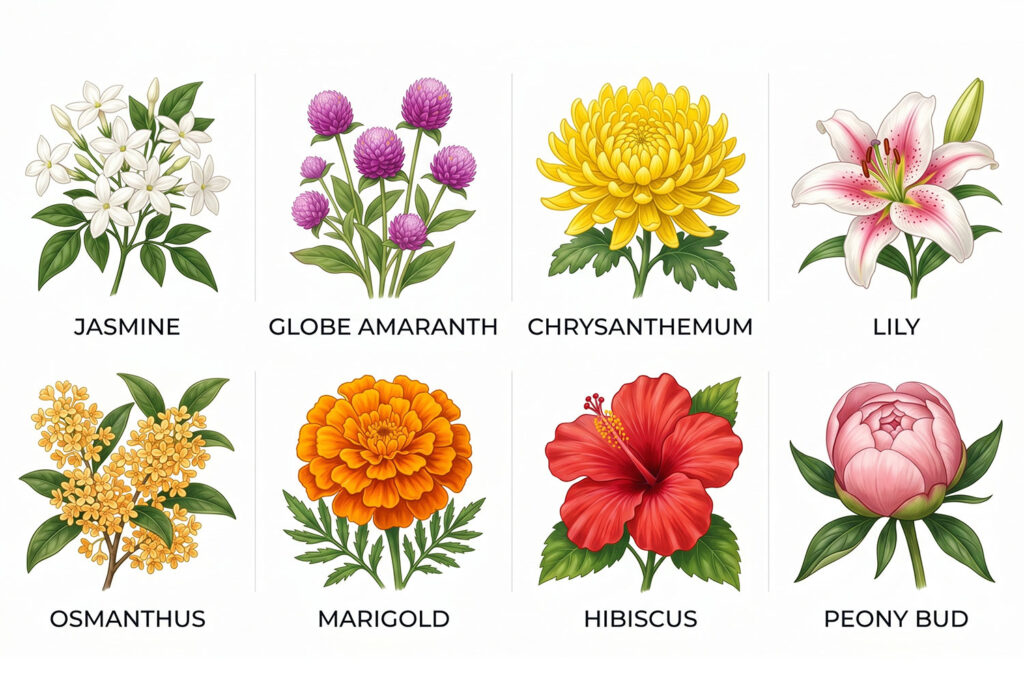
The tea base is almost always white tea or green tea – both of which produce a pale, clear liquor that allows the bloom to be seen in full. A dark black tea would obscure the visual entirely. The flowers used are typically jasmine, osmanthus, globe amaranth, lily, chrysanthemum or marigold – chosen for their ability to hold their form when dried and sewn into the bundle.
The Teapro principle: Flowering tea is not a trick. In its finest form it is a genuine craft – each bundle hand-tied and hand-sewn by skilled artisans in Yunnan and Fujian provinces in China. The flavour, when the base leaf is quality white or green tea, is subtle and genuinely beautiful. It should be understood as an art form, not a gimmick.
Flowering tea originated in China – most accounts place its modern commercial development in Yunnan province in the late 20th century, though the practice of combining dried flowers with tea has roots in Chinese tea culture going back much further. Today it is produced primarily in Yunnan, Fujian and Sichuan provinces, with quality varying enormously between producers.
Quick facts: what is flowering tea?
| Fact | Detail |
|---|---|
| Also known as | Blooming tea, display tea, artisan tea ball, hand-tied tea |
| Origin | China - primarily Yunnan, Fujian and Sichuan provinces |
| Tea base | Almost always white tea or green tea - pale liquor essential for the visual effect |
| Flowers used | Jasmine, osmanthus, chrysanthemum, globe amaranth, lily, marigold - varies by bundle |
| Caffeine content | Low to medium - depends on the base tea used |
| Best brewed in | A glass teapot or tall glass - you need to see through the vessel to appreciate the bloom |
| Re-steepable? | Yes - quality bundles can be re-steeped 3-5 times |
| Gift suitability | Exceptionally high - one of the most visually compelling tea gifts available |
How is flowering tea made?
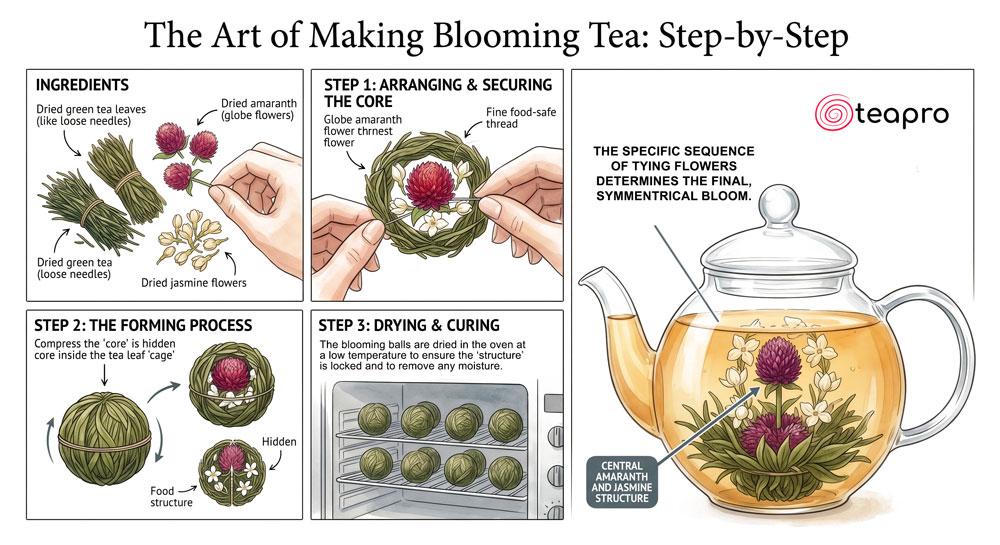
The making of a flowering tea bundle is one of the most labour-intensive processes in the tea world. Each bundle is crafted entirely by hand – and a skilled artisan might make only a few hundred in a working day. Understanding the process is the fastest way to appreciate both the value of a quality bundle and the gap between genuine craft and mass-produced imitation.
- Selecting the tea leaves
Young, pliable white tea or green tea leaves are chosen – typically picked in early spring when the leaves are tender enough to be worked with without cracking or breaking. Silver needle white tea (the top bud only) is the most prized base for premium flowering teas. The leaves must be large enough to be tied and still leave room to expand when steeped.
- Withering and softening
The freshly picked leaves are withered to reduce their moisture content – making them flexible and less brittle. This is the same first stage as in standard white tea production. The degree of withering affects both the final flavour and the workability of the leaf.
- Preparing the flower
The dried flowers are prepared separately. Jasmine buds, globe amaranth flowers, chrysanthemum petals and similar botanicals are dried to remove moisture while retaining their shape and colour. The flower that will be placed at the centre of the bundle must hold its form under the heat of steeping – not all flowers can do this.
- Hand-tying the bundle
The artisan lays out a fan of tea leaves, places the dried flower or flowers at the centre, and folds the leaves around them. The bundle is then tied with thread – often with multiple strands – into a compact ball or teardrop shape. This is precise, painstaking work. The tension of the tie determines how slowly or quickly the bundle opens in water. Too loose and it opens immediately with no drama. Too tight and it doesn’t fully bloom.
- Drying the finished bundle
The completed bundle is dried again at low temperature to stabilise it for storage and shipping. This final drying also gently fixes the shape. Quality bundles are inspected at this stage – any that are misshapen, too loose or too tightly wound are set aside.
- Packaging
Individual bundles are wrapped or boxed to protect them. Quality producers package each bundle separately to prevent damage – the bundles are fragile and a cracked ball will not bloom properly.
The quality indicator: A genuine hand-crafted flowering tea bundle will have slight variations between bundles – in size, in the placement of the flower, in the exact shape. Machine-made or very low-quality bundles are perfectly uniform. Inconsistency, here, is a sign of the human hand.
The flowers used – and what they mean
The choice of flower in a flowering tea bundle is not arbitrary. Each flower brings a different visual character, a different subtle flavour note, and – in traditional Chinese culture – a different symbolic meaning. Understanding the flowers is part of understanding the drink.
| Flower | Colour | Flavour note | Symbolic meaning (traditional Chinese) |
|---|---|---|---|
| Jasmine | White | Floral, sweet, intensely perfumed | Love, beauty, elegance - the most commonly used flower in Chinese tea traditions |
| Globe amaranth | Deep pink / magenta | Mild, slightly sweet and grassy | Immortality and enduring love - holds its shape and colour exceptionally well when dried |
| Chrysanthemum | White or yellow | Delicate, slightly herbal, clean | Longevity and good fortune - a revered flower in Chinese culture and medicine |
| Lily (day lily) | Orange / yellow | Subtle, slightly earthy-sweet | Motherly love and fertility - adds a warm colour contrast in the bloom |
| Osmanthus | Tiny white / orange | Honey-like, apricot-sweet, distinctive | Good luck and prosperity - exceptionally fragrant, a favourite in Fujian teas |
| Marigold | Bright orange / yellow | Mild, slightly bitter-sweet | Bright fortune - adds vivid colour to the bloom rather than significant flavour |
| Hibiscus | Deep red | Tart, fruity, vivid | Rare in flowering tea but used in some blends for colour - brings a beautiful crimson bloom |
| Peony (bud) | Pink to white | Soft floral, gentle rose-like | Wealth, honour and feminine beauty - the peony blossom is considered the queen of flowers in China |
Types of flowering tea
Flowering tea exists on a spectrum from simple single-flower bundles to elaborate multi-layered constructions. Here are the main types and what distinguishes them.
| Type | Base tea | Flower arrangement | Character and best for |
|---|---|---|---|
| Single blossom ball | White tea | One central flower - jasmine, amaranth or chrysanthemum | The classic. Clean, simple, meditative. The standard introduction to flowering tea. |
| Double blossom | White or green tea | Two flowers placed at centre - often contrasting colours | More dramatic bloom. Good for gifting - the colour contrast is striking in a glass pot. |
| Tower / pillar | White tea | Multiple flowers stacked vertically on a skewer of leaf | Produces a tall, architectural bloom. More complex to make - a mark of skilled craftsmanship. |
| Bouquet bundle | Green tea | Several small buds tied at the top, flowering outward | Opens like a bouquet - spectacular visually. Green tea base adds slightly more body to the flavour. |
| Jasmine silver needle | Silver needle white tea | Jasmine bud at centre - premium base leaf | The most prized style. Silver needle is the highest grade white tea - the flavour is genuinely exceptional alongside the jasmine. |
| Scented flowering tea | White or green tea | Flowers sewn in, then tea is also scented during drying | Double floral impact - both visual and in the liquor. Quality versions use natural scenting; avoid artificial. |
| Caffeine-free flowering | Rooibos or herbal base | Same construction method with caffeine-free base | All the visual drama without caffeine. Less traditional but an excellent option for evenings or sensitive drinkers. |
What does flowering tea taste like?
This is the question most people forget to ask – because the visual experience dominates. But flowering tea, when it is made from quality leaf and flowers, tastes genuinely good. It is not simply decorative.
The flavour of flowering tea is determined primarily by the base tea and secondarily by the flowers. Because most flowering teas use white tea as the base, the flavour profile tends toward the delicate side – light, clean, slightly sweet, with a lingering floral note that comes from the flower itself.
| Base tea | Flavour character | With jasmine flower | Best described as |
|---|---|---|---|
| Silver needle white | Honey, melon, light and clean | Intensely floral - jasmine perfume dominant, honeyed finish | Delicate, aromatic, elegant - comparable to a very fine white wine |
| White peony (Bai Mu Dan) | Slightly more body, floral, light fruit | Jasmine + gentle fruity undertones | Soft and rounded - more body than silver needle but still subtle |
| Green tea base | Grassy, fresh, slightly vegetal | Jasmine over a green, slightly brisk background | Brighter and more alive - the green tea adds structure the white tea lacks |
| Jasmine green tea base | Already scented - jasmine throughout | Doubled jasmine character - very perfumed | Highly aromatic - beautiful but intense, not for everyone |
The honest answer about flavour and quality
Low-quality flowering tea can taste of very little – or worse, of artificial flavouring. Cheap bundles are sometimes made from fannings and dust (the lowest grade of tea) wrapped around a dried flower, then sprayed with flavouring to create the appearance of quality. In the cup, these produce a weak, slightly sweet liquid with no real character.
High-quality flowering tea – particularly those using silver needle white tea as the base – produces a genuinely beautiful, complex flavour. The floral notes are real, coming from the actual dried flower steeping alongside the leaf. The liquor is clean and pale. The finish is long and sweet. It is worth seeking out.
How to taste a flowering tea properly: Wait for the bloom to open fully before you drink – roughly 3-4 minutes. Then look at the colour of the liquor. Good quality white tea base produces a pale gold.
Smell before you sip. The aroma should be genuinely floral and fresh. The first sip should be clean, light and sweet – with no artificial aftertaste. If it tastes of nothing or of synthetic flavouring, the quality is low.
Health benefits of flowering tea
Flowering tea inherits its nutritional properties from two sources: the tea base (most commonly white tea) and the dried flowers. Both bring genuinely interesting compounds, though – as always at Teapro – we present the evidence honestly and without overclaim.
| Ingredient | Key compounds | Evidence level | Associated benefits |
|---|---|---|---|
| White tea (base) | Catechins, polyphenols, EGCG, L-theanine | Good evidence | Antioxidant activity - white tea retains high catechin levels due to minimal processing. Calm alertness from L-theanine. |
| Jasmine flower | Linalool, benzyl acetate, polyphenols | Promising | Mild relaxant properties - jasmine aroma has been associated with reduced anxiety in some studies. Antioxidant activity. |
| Chrysanthemum | Flavonoids, luteolin, apigenin | Good evidence | Anti-inflammatory markers, eye health associations (used in Traditional Chinese Medicine for vision), antioxidant. |
| Globe amaranth | Betacyanins, flavonoids, vitamin C | Promising | Antioxidant activity. Anti-inflammatory markers. Holds colour naturally - the deep pink is from betacyanins, not dye. |
| Osmanthus | Beta-ionone, linalool, polyphenols | Limited but positive | Traditional use for digestive comfort and skin health. Strong antioxidant profile. |
| Lily (day lily) | Flavonoids, carotenoids | Limited | Traditional Chinese Medicine uses for stress and mood. Mild antioxidant activity. |
Important note: Flowering tea is a genuinely beautiful experience and carries real nutritional interest from the white tea base and dried flowers. It is not a medicine. The quantities of any specific compound consumed in a cup of flowering tea are modest. We’d never suggest drinking it for health reasons alone – drink it because it is wonderful, and let the rest be a bonus.
Caffeine in flowering tea
Flowering tea contains caffeine – because it is built on a genuine tea leaf base. The amount is lower than most other teas, primarily because white tea naturally contains less caffeine than black or green tea, and because the brewing temperature and time for flowering tea are relatively gentle.
| Comparison | Approx. caffeine | Context |
|---|---|---|
| Filter coffee (250ml) | 95-140mg | High benchmark |
| Black tea (250ml) | 40-70mg | Standard strong brew |
| Green tea (250ml) | 25-45mg | Varies by variety and brew strength |
| Flowering tea - white base (250ml) | 15-30mg | Gentle and low - the most commonly encountered type |
| Flowering tea - green base (250ml) | 20-40mg | Slightly more than white base |
| Flowering tea - silver needle base (250ml) | 10-25mg | The finest white tea base - naturally very low caffeine |
| Caffeine-free flowering tea (rooibos base) | Zero | Same visual bloom, no caffeine whatsoever |
Flowering tea is one of the lower-caffeine true tea options available – making it suitable for afternoon or early evening drinking for most people. If caffeine is a significant concern, rooibos-based flowering teas offer the full visual experience without any stimulant effect.
How to brew flowering tea properly
Brewing flowering tea correctly matters for two reasons: the flavour and the bloom. Both are affected by water temperature, vessel choice and patience. Get these right and the experience is extraordinary.
What you need
| Item | Why it matters |
|---|---|
| A glass teapot or tall glass vessel | Non-negotiable. The entire experience is visual - you must be able to see through the vessel. A ceramic or stainless pot makes flowering tea pointless. |
| One flowering tea bundle per 300-400ml | The bundle needs space to fully expand. Overcrowding prevents a full bloom and dilutes both flavour and visual impact. |
| Water at 80-85C | Never boiling. White tea (the most common base) is delicate - boiling water scorches the leaf and produces bitterness. 80C produces clean, sweet flavour. |
| Patience - 3-5 minutes | The bloom opens slowly. Watch it. That's the point. Don't rush it. |
| Filtered water if possible | Particularly important with white tea base - the flavour is subtle and hard water minerals can overwhelm it. |
Step-by-step brewing guide
- Warm the vessel
Pour a small amount of hot water into your glass teapot or glass, swirl and discard. This prevents temperature shock when the brewing water goes in – and stops the bundle from cooling too quickly.
- Place the bundle in the vessel
Drop the flowering tea bundle gently into the warmed vessel. Place it seam-side down if you can see a seam – the bloom opens upward and the flower reveals itself from the top. Some artisans tie a small thread at the bottom that helps orient the bundle.
- Pour water at 80-85C
Pour slowly and directly over the bundle. Watch it immediately begin to absorb water and start to expand. The thread holding the bundle in place will slacken as the leaves hydrate.
- Watch and wait
This is the heart of the experience. Over 3-5 minutes, the leaves gradually open outward from the centre, revealing the flower suspended in the pale gold or jade liquor. The bloom is usually complete within 4-5 minutes. Different bundles open at different rates – tighter bundles open more slowly and dramatically.
- Taste before you pour
Before tipping the pot or drinking from the glass, inhale first. The steam carries the floral and tea aromas beautifully. The first sip should be taken while the bloom is at its fullest – there is something about tasting the tea while looking at the flower that changes how it registers.
- Re-steep 3-5 times
Leave the bloom in the vessel and simply add fresh hot water at the same temperature. Each subsequent steep will be slightly lighter – the first two steeps are the most flavourful. By the fourth or fifth steep, the tea is very delicate indeed – almost like scented water, which is its own pleasure.
The re-steep ritual: A quality flowering tea bundle is meant to be used multiple times through a sitting. In traditional Chinese tea culture, the repeated steeping of a single bundle over an hour or two is itself the meditative experience. The liquor changes, the bloom ages slightly, the flavour becomes more delicate. Each cup is different.
Brewing guide at a glance
| Base type | Water temp | 1st steep time | Re-steeps | Vessel |
|---|---|---|---|---|
| White tea base (silver needle) | 75-80C | 4-5 min | 4-5 times | Glass only |
| White tea base (white peony) | 80C | 3-5 min | 3-4 times | Glass only |
| Green tea base | 75-80C | 3-4 min | 3-4 times | Glass only |
| Jasmine green tea base | 75-80C | 3-4 min | 2-3 times | Glass only |
| Rooibos base (caffeine-free) | 90-95C | 5-6 min | 2-3 times | Glass only |
Flowering tea as a gift
Flowering tea is one of the most naturally gift-ready products in the tea world. The visual drama of the bloom, the hand-crafted quality of each bundle, the ceremony of brewing it together – these combine into an experience that is difficult to replicate with almost any other tea.
Why it works as a gift
| Gift quality | Why it matters |
|---|---|
| Visually spectacular | The bloom is genuinely astonishing for someone who has never seen it. It invites the recipient to stop, watch and be present. |
| A shared experience | Brewing flowering tea together - watching the bloom open - is an experience in itself. It converts a gift into a moment. |
| Accessible without expertise | Unlike single-origin loose leaf tea, flowering tea requires no palate development to be enjoyed. The beauty is immediate. |
| Elegant and unusual | It reads as thoughtful and carefully chosen - not a last-minute generic gift. |
| Suitable for most people | White tea base is low caffeine, gentle flavoured and naturally caffeine-lower than most teas. Suits a wide range of recipients. |
| Gateway to real tea | For recipients who normally drink only builder's tea or coffee, flowering tea is one of the most compelling introductions to the wider tea world. The curiosity it creates is real. |
The Teapro gift angle:
At Teapro, we see flowering tea as one of the most powerful gateway gifts – it introduces someone to the idea of tea as an experience rather than just a hot drink.
Pair it with a glass teapot and a short education note about what they’re looking at, and you’ve given someone something they’ll remember.
What to pair with flowering tea as a gift
| Pairing | Why it works |
|---|---|
| Glass teapot (with infuser) | Essential for the visual experience. A clear glass teapot transforms flowering tea from a drink into theatre. |
| A glass cup or mug | Allow the liquor's colour to be appreciated - again, the visual element matters throughout. |
| A small card explaining the bloom | Education is part of the Teapro experience. Tell the recipient what flower is inside and what it means. |
| A Teapro gift set | Pair flowering tea with one or two other Teapro teas - a quality green or white tea - to introduce the recipient to the broader tea world. |
| Jaggery or raw honey | For recipients who like a little sweetness - both complement white tea-based flowering tea beautifully without overpowering the floral notes. |
How to buy flowering tea well
The flowering tea market contains a significant amount of low-quality product – bundles made from fannings, sprayed with artificial flavouring and dressed up in attractive packaging. The visual drama of the category makes it easy to sell badly made product. Here’s how to navigate it.
| Look for | Avoid |
|---|---|
| Named base tea on the ingredients list - silver needle, white peony, green tea - not just 'tea' | Unlabelled 'tea base' with no variety or origin information |
| Named real flowers - jasmine, chrysanthemum, globe amaranth - not 'floral flavouring' | 'Natural flavouring' or 'floral flavouring' as the scent source - the flower should be visible and real |
| Hand-crafted labelling with some detail about the maker or region (Yunnan, Fujian) | No provenance information - anonymous sourcing means unverifiable quality |
| Slight variation between bundles - small differences in size and shape signal hand-crafting | Perfectly identical bundles - signs of machine assembly with minimal real leaf content |
| A glass teapot included or recommended - brands that understand the product tell you to watch it | No brewing instructions, or instructions for a mug with no mention of a glass vessel |
| Bundles packaged individually to prevent damage | Loose bundles rattling together in a box - cracked bundles won't bloom properly |
| A pale, clear liquor when brewed - not murky or artificially coloured | Vivid, unnatural liquor colour - some low-grade bundles are artificially coloured |
The single most important test
Before buying, ask one question: can you see a real, identifiable flower in the bundle? If the product photography shows a clear bloom with a distinct flower at the centre – jasmine, chrysanthemum, amaranth – and the ingredients list confirms that flower by name, you are likely looking at a genuine product. If the bundle is opaque, the flower is unidentifiable, or the ingredients list is vague, move on.
The Teapro standard: Every flowering tea we stock uses a named base tea and identifiable real flowers. We include information on the origin, the flower used and what it means. The education is part of the experience – and understanding what’s in your cup changes how you taste it.
Frequently asked questions
None – they are the same thing. ‘Flowering tea’, ‘blooming tea’ and ‘display tea’ are all terms used for the same hand-crafted product: a tied tea bundle that opens into a flower when steeped in hot water. ‘Flowering tea’ is the most common term in the UK; ‘blooming tea’ is used more widely in the US.
Yes – most flowering teas use a genuine tea leaf base, most commonly white tea or green tea from the Camellia sinensis plant. The flower is an addition, not a replacement. Some versions use a caffeine-free base such as rooibos, which is not a true tea leaf – these are clearly labelled as caffeine-free.
A quality flowering tea bundle can typically be re-steeped 3-5 times. The first and second steeps are the most flavourful. By the fourth or fifth, the liquor is very delicate – almost like lightly scented warm water. The bloom remains open and visible throughout all steeps. Simply top up with fresh hot water at the same temperature each time.
Yes – when it is good quality. A flowering tea made from silver needle white tea with a real jasmine flower produces a genuinely beautiful, clean, subtly sweet and floral cup. Low-quality flowering teas (made from fannings with artificial flavouring) can taste weak or synthetic. The quality gap in this category is significant – and the flavour is the clearest indicator of whether the product is genuine.
You need a clear glass vessel – a glass teapot is ideal, but a tall glass or a glass mug works perfectly well. The visual experience is the point, and an opaque ceramic or metal pot removes it entirely. A glass teapot with a lid keeps the water hotter for longer, which helps the later steeps.
Yes – flowering teas made from food-grade tea leaves and real dried flowers are completely safe. The flowers used (jasmine, chrysanthemum, globe amaranth, lily, osmanthus) are all established culinary and tea-grade botanicals. If you have specific flower allergies, check the ingredients list. Pregnant women should check individual flower ingredients – some botanicals warrant caution during pregnancy.
The most common reasons are: water that’s too cool (below 75C) which prevents full hydration of the leaves; a vessel that’s too small (the bundle needs room to expand); a bundle that’s been damaged in transit (a cracked bundle won’t open symmetrically); or a very low-quality bundle made with minimal real leaf. Use 80C water, give the bundle a full glass teapot or tall glass to expand into, and wait at least 4-5 minutes.
Each flower carries traditional Chinese symbolic meaning – jasmine represents love and elegance, chrysanthemum represents longevity and good fortune, globe amaranth represents enduring love, osmanthus represents prosperity. These meanings are part of what makes flowering tea a particularly thoughtful gift – the flower you choose carries a message.
Technically yes – the flowers used in flowering tea are food-grade. However, they are quite fibrous and dense after steeping and most people simply discard the spent bundle after brewing. The flavour compounds from the flower have already released into the liquor during steeping – what remains in the bundle is largely structural.
About Teapro
Teapro is a UK-based premium loose leaf tea brand. We source the purest single-origin teas and natural herb blends we can find. We believe artificial flavourings mask the real taste of tea – so wherever possible, we let the leaf speak for itself.
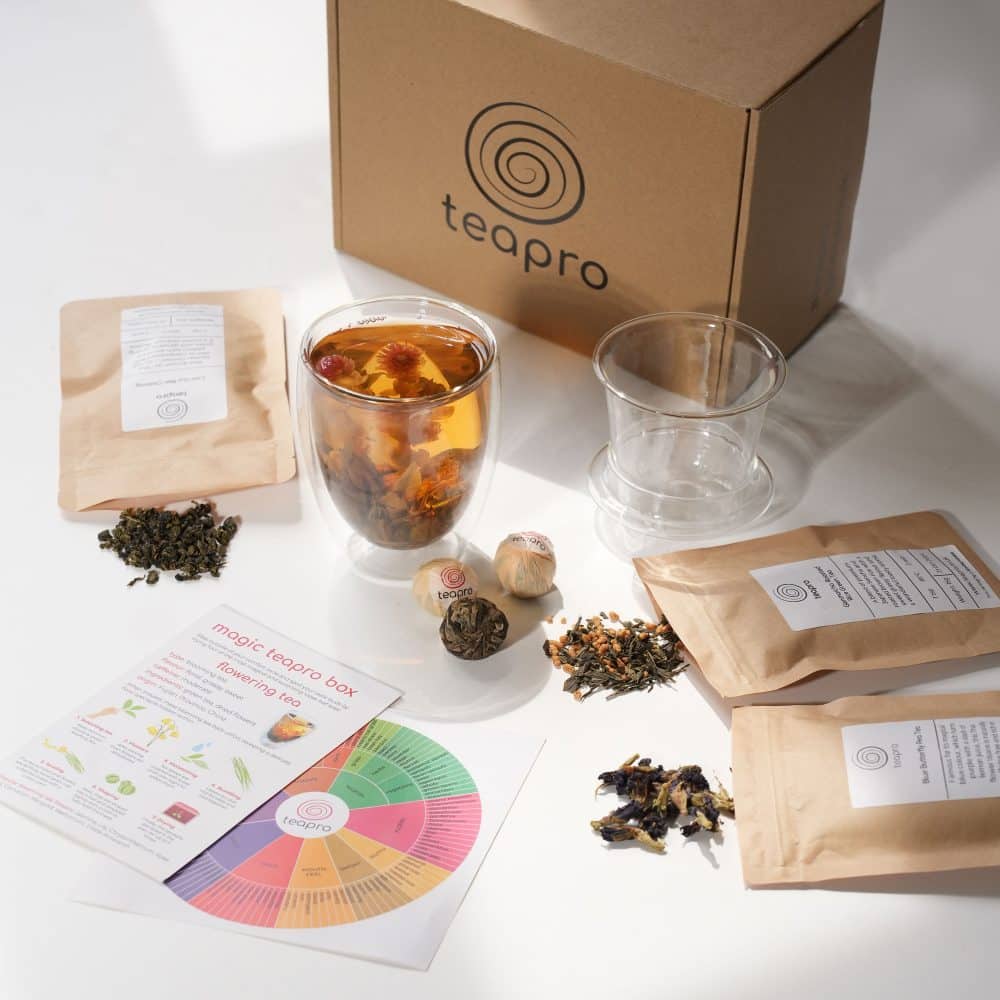
Our ‘Become a Teapro’ 12-box subscription is the only structured tea education programme of its kind in the UK – covering green, black, herbal, chai, oolong, pu-erh, yerba, matcha, fruit, white, magic and rooibos. The flowering teas are inside the “magic” tea box.

Teapro co-founder. Favourite tea - Long Jing Dragon Well Green Tea. Obsessed with film, photography and travelling.


No Comments