What is Rooibos Tea? The Complete Guide to South Africa’s Red Bush

Rooibos is not a tea. Not technically. And that single fact explains almost everything that makes it special.

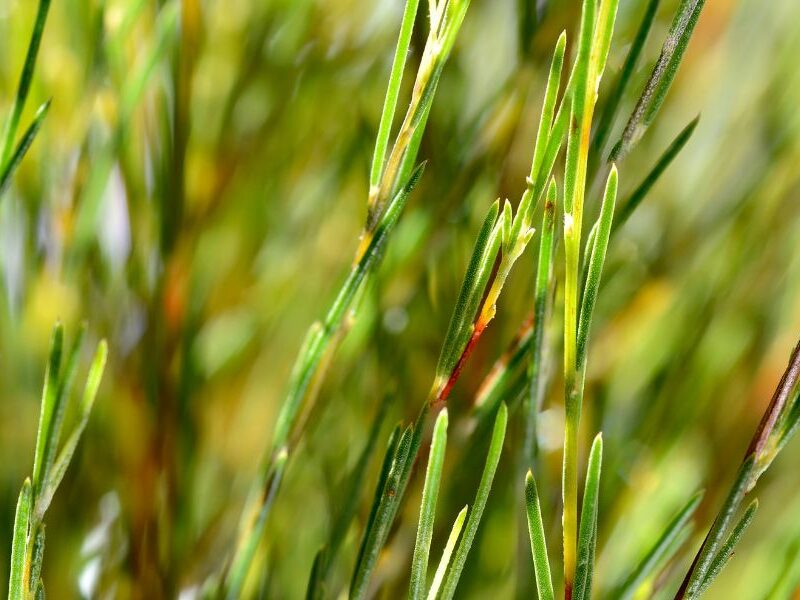
So what is rooibos tea? Unlike black, green, white, oolong, and pu-erh – all of which come from the Camellia sinensis plant – rooibos is a tisane, or herbal infusion, made from the needle-like leaves of Aspalathus linearis, a shrub native to a single mountain range in the Western Cape of South Africa.

It contains no caffeine. It contains no tannins (at meaningful levels). And when it is grown, harvested, and processed purely – without artificial flavourings added to paper it over – it has a flavour profile unlike anything else in the world of hot drinks.

This guide covers everything you need to know: what rooibos is, where it comes from, how it is made, what it tastes like, how to brew it correctly, what the health evidence actually says, and why pure loose leaf rooibos is a completely different experience from the rooibos teabags most people in the UK have encountered.

What’s in this guide:

What is Rooibos tea? The Essential Definition

Rooibos (pronounced ROY-boss in English, from the Afrikaans for ‘red bush’) is a herbal infusion made from the fermented leaves and stems of Aspalathus linearis, a leguminous shrub in the Fabaceae family. It grows exclusively in the Cederberg mountain region of the Western Cape, South Africa, at altitudes of 450 to 1,500 metres above sea level.

Because it does not come from Camellia sinensis, rooibos is not technically a tea under botanical classification. In common usage, it is called a ‘herbal tea’ or ’tisane’ – a category that covers all plant-based hot drinks made from something other than the tea plant.

This distinction matters because it explains rooibos’s most defining characteristics: no caffeine, low tannin content, and a unique antioxidant profile found nowhere else.

Rooibos has been consumed by the indigenous Khoisan people of the Cederberg for centuries. Commercial cultivation began in the early 20th century, and today South Africa exports rooibos to over 60 countries.

Despite this, the plant has never been successfully cultivated outside its native region – the specific combination of climate, soil acidity, and altitude cannot be replicated elsewhere.

Rooibos is an endemic crop – meaning it grows nowhere else on Earth except the Cederberg mountains. This is not marketing language. It is a botanical fact. Every cup of rooibos in the world came from a 250km stretch of South African mountain fynbos.

Where Rooibos Comes From: The Cederberg Region

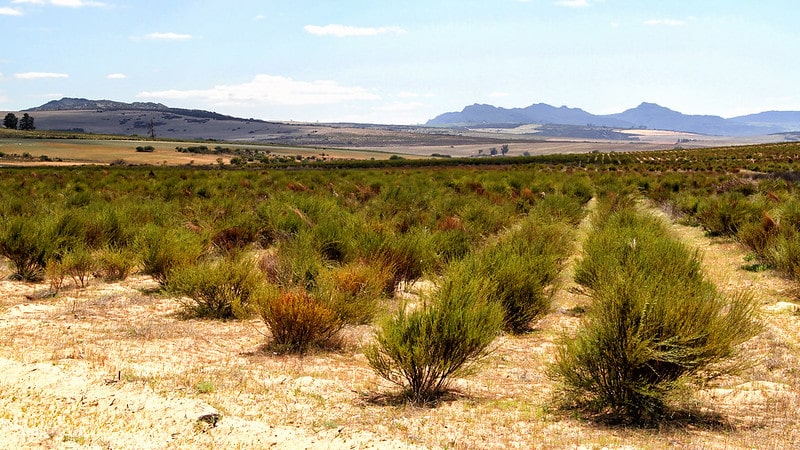
The Cederberg Wilderness Area sits approximately 200 kilometres north of Cape Town in the Western Cape province of South Africa. It is a UNESCO-recognised biodiversity hotspot – part of the Cape Floristic Region, one of only six floral kingdoms in the world, and home to over 9,000 plant species found nowhere else.


Rooibos Tea field in South Africa

The conditions that make rooibos possible are highly specific:

  • Soil: Sandy, acidic, and nutrient-poor. Rooibos, like many legumes, fixes nitrogen through root nodules, allowing it to thrive where other crops cannot.

  • Altitude: Between 450 and 1,500 metres above sea level, with cooler temperatures that slow growth and concentrate flavour compounds.
  • Temperature: Hot summers (up to 40 degrees C) and cold winters, with occasional frost at higher altitudes.
  • Rainfall: Low and seasonal (300-400mm annually), concentrated in winter months. Dry summers stress the plant, triggering antioxidant production as a defence mechanism – which is partly why rooibos has such a distinctive antioxidant profile.

The harvest season runs from December to March (Southern Hemisphere summer). Mature shrubs are harvested after 18 months to 3 years of growth. The entire process – from wild plants to processed leaf – remains labour-intensive and largely localised to a small number of farming communities and cooperatives in the Cederberg.

Why This Matters: Because rooibos cannot be grown outside the Cederberg, every producer competes on processing quality, not geography. This is why the difference between mass-market rooibos teabags and premium loose leaf rooibos comes entirely down to how the leaf is handled after harvest.

How Rooibos is Made: Fermented vs. Green Rooibos

There are two types of rooibos, and understanding both is essential to understanding what you are buying.

Fermented (Red) Rooibos

This is the type most people in the UK have encountered, though usually in a teabag rather than as loose leaf.

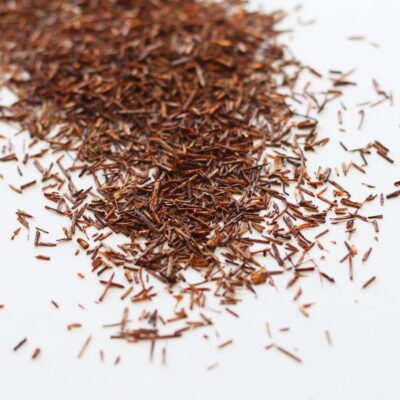
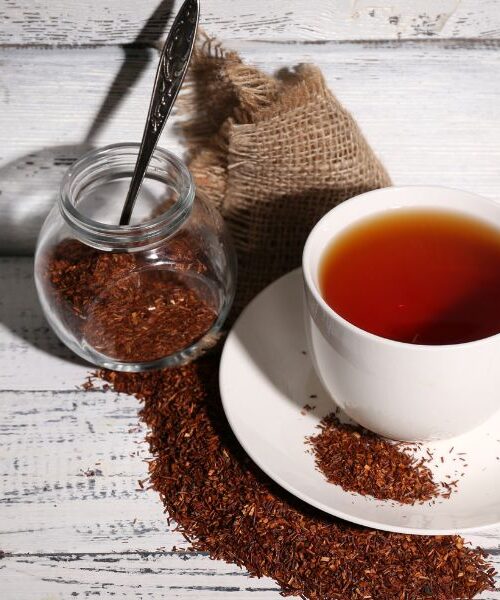
After harvest, the plant material – leaves and thin stems – is chopped, bruised, and left in heaps to undergo a controlled oxidation process (often called ‘fermentation’ in the rooibos industry, though it is technically enzymatic oxidation, similar to the process used for black tea).

The process unfolds as follows:

Loading...
rooibos tea
Price range: £4.50 through £70.00
  • Cutting and bruising: Harvested plant material is cut into short lengths (3-5mm) and bruised to break cell walls and release enzymes.
  • Oxidation (‘fermentation’): The bruised material is spread into heaps and left for 8-24 hours in warm, humid conditions. Enzymatic reactions transform green aspalathin – rooibos’s signature antioxidant – into other oxidised compounds, and the plant turns from green to its characteristic deep red-brown colour.
  • Drying: Oxidation is halted by spreading the material in the sun to dry. Water content drops to below 8%.
  • Sorting and grading: Dried material is passed through sieves to remove stems, then graded by particle size and quality.

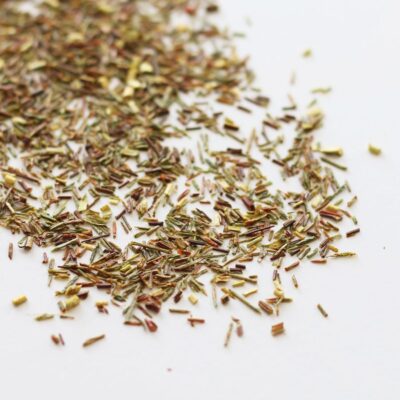
The result is the familiar reddish-brown rooibos with its naturally sweet, earthy, slightly woody flavour.

Green (Unfermented) Rooibos

Green rooibos skips the oxidation step entirely. After harvesting and cutting, the plant material is immediately dried – either by steam-fixing (similar to Japanese green tea processing) or rapid air-drying – to halt enzymatic activity and preserve the fresh, green leaf.

The result is a lighter-coloured infusion with a greener, grassier, more delicate flavour profile and a dramatically higher concentration of aspalathin – rooibos’s primary antioxidant compound.

Because less aspalathin has been converted by oxidation, green rooibos contains approximately 10 times the aspalathin content of fermented rooibos.

Green rooibos is more expensive to produce (more careful handling, faster processing) and has a shorter shelf life. It is substantially rarer in the UK market, which means most people have never tasted it.

Loading...
Price range: £4.50 through £60.00
Fermented (Red) Rooibos Green Rooibos
Processing Oxidised 8-24 hours Unoxidised - rapid drying
Colour (dry leaf) Dark red-brown Green to pale yellow
Colour (brewed cup) Deep amber to red Pale gold to yellow-green
Flavour Earthy, sweet, woody, mellow Grassy, fresh, lighter, slightly vegetal
Aspalathin content Lower (oxidation converts it) Approximately 10x higher
Availability in UK Widely available Rare - specialist only
Shelf life 2-3 years properly stored 12-18 months

What Does Rooibos Taste Like?

This is the question most guides avoid answering precisely. Let’s be specific.

Fermented rooibos has a naturally sweet flavour without added sugar. The sweetness comes from its low tannin content combined with trace natural sugars and the flavour compounds produced during oxidation.

It is earthy in the way that a forest floor after rain is earthy – not unpleasant, but grounded. There are notes of vanilla (particularly in higher-quality loose leaf), a mild nuttiness, and a slight woody depth. The finish is clean and smooth.

Compared to black tea, rooibos has no astringency. Tannins are responsible for the dry, puckering sensation you feel in a strong cup of breakfast tea – rooibos has almost none.

This is why it is often described as ‘smooth’ or ‘mellow,’ and why it works so well as an evening drink.

Green rooibos tastes quite different: lighter, fresher, with a gentle vegetal note and a cleaner finish. Think of it as the white tea of the rooibos world.

The most common reason people do not enjoy rooibos is over-brewing. Rooibos does not become bitter with longer steeping (unlike black tea), but it does become flat and heavy. The sweet, smooth character gets muted. The brewing guide in Section 6 fixes this.

Tasting Notes by Quality Level

  • Mass-market rooibos teabag: One-dimensional sweetness, slight dustiness, flat earthy base. Often supplemented with artificial vanilla or fruit flavourings to add interest.
  • Mid-grade loose leaf: Cleaner, more rounded sweetness. Vanilla and light wood notes emerge. The difference from a teabag is immediately noticeable.
  • Premium single-origin loose leaf: Complex natural sweetness, distinct vanilla and honey notes, a smooth earthy base with good length on the finish. This is rooibos at its most expressive.

Rooibos vs. Black Tea: The Key Differences

Rooibos Black Tea
Plant source Aspalathus linearis Camellia sinensis
Category Herbal tisane True tea
Caffeine None (0mg per cup) 40-70mg per 250ml cup
Tannins Negligible Significant (responsible for astringency)
Primary antioxidants Aspalathin, nothofagin (unique to rooibos) Theaflavins, thearubigins, catechins
Origin Cederberg, South Africa only India, China, Sri Lanka, Kenya, etc.
Brewing temp 95-100°C 85-100°C (varies by type)
Can it overbrew? Flavour flattens but no bitterness Yes - becomes bitter and harsh
With milk? Optional - works well Traditional, but varies by type
Best time to drink Any time, including evening Morning/daytime preferred (caffeine)
The practical upshot: if you are reducing caffeine, avoiding tannin-related digestive sensitivity, or looking for something to drink in the evening without disrupting sleep, rooibos is the genuinely different choice – not a compromise.

How to Brew Rooibos Properly

Rooibos is one of the most forgiving teas to brew – but ‘forgiving’ does not mean ‘any method works equally well.’ Here is what the variables actually do.

Water Temperature

Use water at or close to 100 degrees C (just boiled). Unlike delicate green teas or first-flush Darjeelings, rooibos can handle full boiling water without the scorching effect you would get with more delicate teas. In fact, using water that is too cool (below 90 degrees C) underextracts the sweet compounds and produces a flat, slightly sour result.

Quantity

2 to 3 grams of loose leaf rooibos per 250ml of water. Rooibos leaves are lightweight and bulky – 2-3 grams takes up considerably more space than the equivalent weight of black tea. A standard dessertspoon is approximately the right amount for a mug.

Steep Time

5 to 7 minutes for fermented (red) rooibos. Rooibos does not become bitter with longer steeping, but beyond 8-10 minutes the flavour becomes heavy and the natural sweetness is masked. For green rooibos, 4 to 6 minutes is sufficient.

Type Water Temp Quantity Steep Time Milk?
Fermented (red) rooibos 95-100 degrees C 2-3g per 250ml 5-7 minutes Optional - works well
Green rooibos 90-95 degrees C 2-3g per 250ml 4-6 minutes Not recommended
Rooibos latte 95-100 degrees C 3-4g per 250ml 6-8 minutes (stronger) Yes - oat milk works particularly well

Teapro Tip: Rooibos makes an excellent base for a caffeine-free latte. Brew it stronger than you normally would (3-4g per 250ml, 7 minutes), then top with steamed oat milk. The natural sweetness of rooibos pairs well with oat milk’s slight creaminess. No sugar needed.

Cold Brew Rooibos

Rooibos cold brews exceptionally well. Add 5-6g of loose leaf rooibos per 500ml of cold water, seal, and refrigerate for 8-12 hours.

The result is a smooth, lightly sweet, naturally caffeine-free iced tea with no bitterness. It keeps refrigerated for up to 3 days.

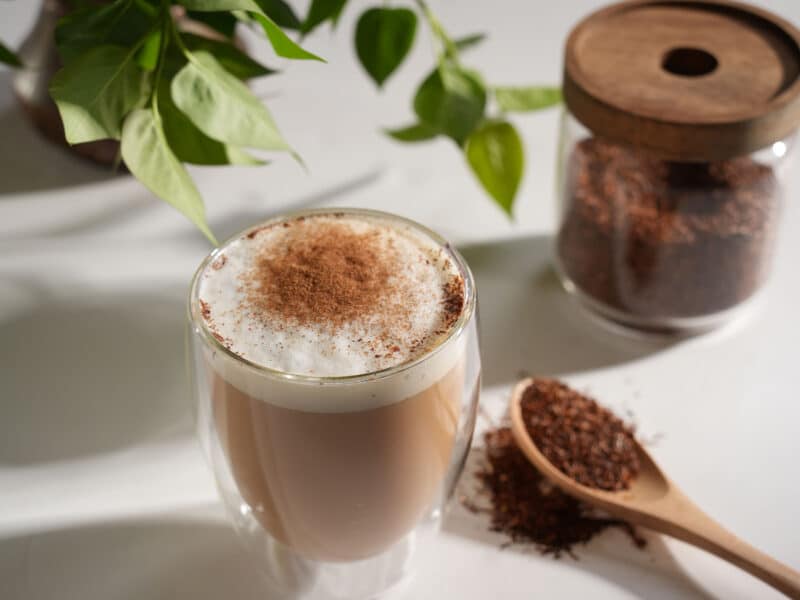
Rooibos Latte

A rooibos latte is a caffeine-free alternative to the traditional coffee latte, made by brewing a strong cup of rooibos tea and topping it with steamed milk.

Naturally sweet and earthy, rooibos pairs beautifully with milk – particularly oat milk, which complements its warm, woody notes without overpowering them. 

Smooth, comforting, and gentle on the stomach, it makes the perfect morning or evening drink for those who want the cosy feel of a latte without the caffeine.

Can You Re-steep Rooibos?

Generally, no. Unlike oolong or some green teas that reward multiple infusions, rooibos releases most of its flavour compounds in the first steep. A second steep at the same temperature will be noticeably thinner. If you want a stronger cup, increase the quantity rather than re-steeping.

Rooibos and Caffeine: The Complete Picture

Rooibos contains no caffeine. This is not a ‘reduced caffeine’ or ‘naturally low caffeine’ claim – it is zero, because caffeine biosynthesis requires a biochemical pathway that Aspalathus linearis simply does not have.

Unlike decaffeinated teas (which begin with caffeine and remove it through chemical or CO2 processes), rooibos never contained caffeine at any point in its existence.

The practical implications:

For those moving away from coffee or reducing black tea intake, rooibos offers something important: a genuinely satisfying hot drink that does not require a caffeine dependency to be enjoyable. The natural sweetness and full body make it more satisfying than most herbal alternatives.

Rooibos contains no caffeine by nature – not by processing. This makes it categorically different from decaffeinated black or green tea, where the original caffeine has been removed (often affecting flavour in the process).

Health Benefits of Rooibos: The Evidence

The health research on rooibos is growing but remains less extensive than the literature on black or green tea. Here is an honest summary of what is known, what is emerging, and what is currently unclear.

Aspalathin: The Unique Antioxidant

Rooibos’s most significant bioactive compound is aspalathin (C21H24O11), a dihydrochalcone flavonoid found only in Aspalathus linearis. No other plant species on Earth produces it. Aspalathin is a potent antioxidant and has been studied in vitro and in animal models for potential roles in:

  • Blood glucose regulation – aspalathin has been shown in cell and animal studies to stimulate insulin secretion and improve glucose uptake. Human clinical trial data is still limited but emerging.
  • Cardiovascular protection – antioxidant activity may help reduce oxidative stress markers associated with cardiovascular disease risk.
  • Anti-inflammatory activity – aspalathin and its oxidised derivatives have demonstrated anti-inflammatory effects in laboratory conditions.

Mineral Content

Rooibos is a natural source of several minerals including calcium, magnesium, manganese, zinc, and fluoride – all present in amounts that contribute meaningfully to daily intake when rooibos is consumed regularly (3-6 cups per day). It is not a supplement, but as a daily drink it has a more substantial mineral profile than most herbal teas.

No Tannin-Related Interference with Iron Absorption

One established and clinically relevant benefit: because rooibos contains negligible tannins, it does not inhibit non-haem iron absorption in the way that black tea does. Black tea consumed with or immediately after a meal can reduce iron absorption by up to 60-70% in some studies. Rooibos has no such effect, making it a useful alternative for anyone with low iron stores or iron-deficiency anaemia.

Digestive Comfort

Rooibos has been used traditionally in South Africa for digestive complaints, and there is some evidence supporting antispasmodic effects in the gut. It is commonly recommended for infant colic in South Africa, though clinical evidence for this specific use remains limited.

Teapro’s Position on Health Claims: Rooibos research is promising but still developing. The aspalathin findings are genuinely interesting – especially the blood glucose work – but most studies are in vitro or animal models. We report the evidence accurately rather than overclaiming. Consult a medical professional for health concerns.

Why Loose Leaf Rooibos is Different

Most rooibos consumed in the UK comes in teabags. Most of that rooibos has been CTC-processed into small, uniform particles with high surface area – designed to brew fast in a bag, not to express the full flavour of the plant.

Premium loose leaf rooibos uses longer cuts of leaf and stem, processed more carefully and dried more slowly. The result brews differently: more slowly, more completely, and with significantly more aromatic complexity.

The second issue is flavouring. Many commercial rooibos products – including a significant proportion of what is sold in UK supermarkets – contain added artificial flavourings.

Vanilla flavouring is particularly common, added to mimic the natural vanilla notes present in high-quality rooibos.

The problem is that artificial vanilla masks rather than expresses the actual character of the rooibos underneath.

Once you know what naturally sweet, vanilla-forward single-origin rooibos actually tastes like, the artificial version is immediately obvious.

Our Position: Teapro does not use artificial flavourings. The natural sweetness and vanilla notes in our rooibos are there because the plant produced them, not because a flavourist added them. This is what we mean when we say pure rooibos speaks for itself..

Single-Origin Rooibos

Most commercial rooibos is blended from multiple farms across the Cederberg to achieve a consistent flavour year-round. Single-origin rooibos – from one specific farm or cooperative – has more character: you can taste the specific expression of that soil, that altitude, that harvest season. It changes slightly from year to year, just as a good wine does.

The Teapro Rooibos Collection

Rooibos is month 12 of the ‘Become a Teapro‘ programme – the culmination of a year-long journey through 12 tea types.

By the time subscribers reach rooibos, they have developed the palate and vocabulary to appreciate exactly what makes a pure, single-origin rooibos exceptional.

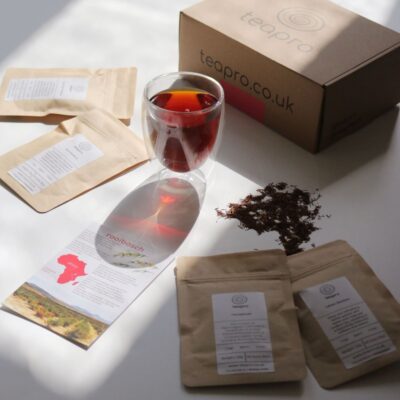
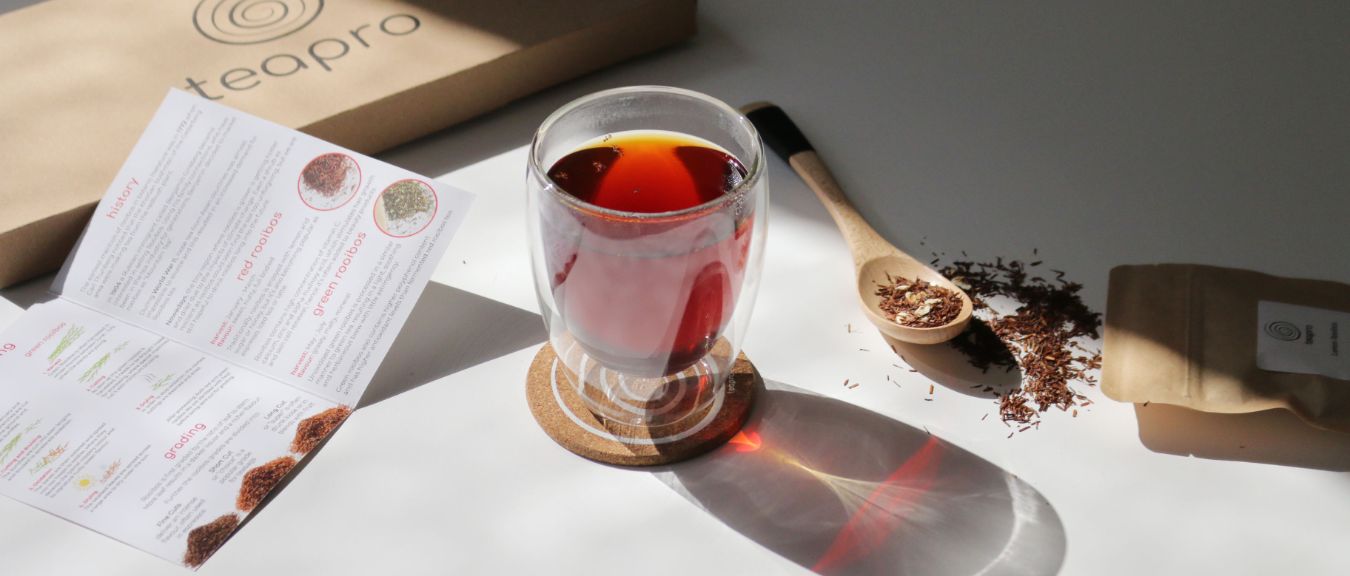
But rooibos does not require 11 months of education to enjoy. If you are new to loose leaf, our Rooibos Gift Box is a self-contained introduction: curated single-origin rooibos, a brewing guide, and tasting notes that explain what to look for. It is designed so that the recipient walks away with knowledge, not just tea.

Loading...
Price range: £18.00 through £35.00

FAQ: Everything Else You Need to Know

The evidence is positive and growing. Rooibos contains aspalathin – a unique antioxidant found nowhere else – along with a useful mineral profile. It does not inhibit iron absorption (unlike black tea), contains no caffeine, and has negligible tannin content. The health research is not yet at the level of black or green tea (which have been studied for decades), but what exists is encouraging.

No. Rooibos contains zero caffeine – not ‘low caffeine’ or ‘naturally low caffeine,’ but none at all. This is because Aspalathus linearis does not have the biological pathway to produce caffeine. It is inherently caffeine-free, which is categorically different from decaffeinated tea.

Fermented (red) rooibos tastes naturally sweet, earthy, and smooth, with notes of vanilla, light wood, and honey. It has no bitterness or astringency. Green rooibos is lighter, fresher, and slightly more vegetal. Both are quite different from any Camellia sinensis tea.

Yes – it is one of the best evening drinks available precisely because it contains no caffeine. It will not interfere with sleep, and its naturally smooth sweetness makes it satisfying without needing sugar or sweetener.

Yes. ‘Red bush tea’ is the English translation of ‘rooibos’ (Afrikaans for ‘red bush’). They are the same plant, the same product, and the same drink. Some UK brands use ‘red bush’ on packaging; others use ‘rooibos’. Both refer to Aspalathus linearis from the Cederberg region of South Africa.

Fermented (red) rooibos is oxidised after harvest, producing its characteristic deep colour, earthy sweetness, and lower aspalathin content. Green rooibos skips oxidation entirely, resulting in a lighter colour, fresher flavour, and approximately 10 times higher aspalathin concentration. Green rooibos is rarer, more expensive, and has a shorter shelf life.

Rooibos is widely considered safe during pregnancy because it is naturally caffeine-free. Current NHS guidance recommends limiting caffeine to 200mg per day during pregnancy; rooibos contributes zero. However, always consult your midwife or GP regarding your specific dietary choices during pregnancy.

In an airtight, opaque container away from light, heat, and moisture. A ceramic or tin caddy works well. Fermented rooibos keeps at peak quality for 2-3 years properly stored. Green rooibos is more delicate and should be used within 12-18 months.

The most likely cause is water that is not hot enough (below 90 degrees C), too short a steep time, or too little leaf. Rooibos needs close-to-boiling water and a full 5-7 minutes to develop its natural sweetness. A second possibility: if you are using a teabag, the particle size and grade of the rooibos inside is simply lower quality. Switching to loose leaf almost always resolves the problem.

In terms of flavour complexity, yes – significantly. Teabag rooibos is typically CTC-processed into fine particles that brew fast but lack depth. Many commercial rooibos teabags also contain artificial vanilla or other flavourings. Premium loose leaf rooibos from a single origin, brewed correctly, is a completely different drink.

Your Next Step

Rooibos is one of the most accessible entry points into the world of pure, loose leaf herbal teas – and one of the most misunderstood. Most people in the UK have only encountered it in a teabag, supplemented with artificial flavouring, brewed in water that was not quite hot enough for not quite long enough.

What they have tasted is a faint outline of what rooibos actually is.

The real thing – single-origin, pure, brewed correctly – has a natural sweetness, a smooth body, and a warmth that makes it one of the most genuinely satisfying hot drinks available. Caffeine-free. No bitterness. No compromise.

Begin the Journey: Become a Teapro‘ is the UK’s only 12-box structured tea education programme. It takes you through 12 tea types – from black tea through oolong, pu-erh, matcha, white tea, and of course, rooibos. Each box includes curated loose leaf teas, brewing guidance, and tasting education. This is how tea drinkers become tea pros.

Teapro co-founder. Favourite tea - Long Jing Dragon Well Green Tea. Obsessed with film, photography and travelling.

No Comments

Post A Comment