12 Apr Rooibos Tea Origin: The Land, the Khoisan, and a Tea the World Almost Never Knew
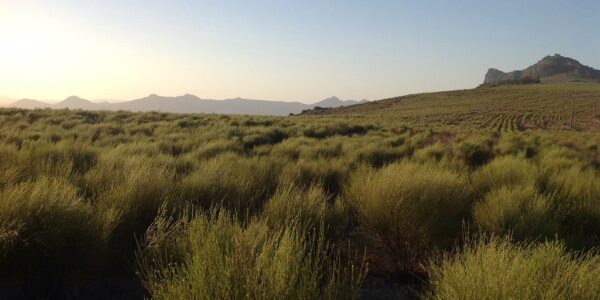
There is a remote corner of South Africa where the mountains are ancient, the soil is rust-red, and a wiry little shrub grows that exists nowhere else on Earth.
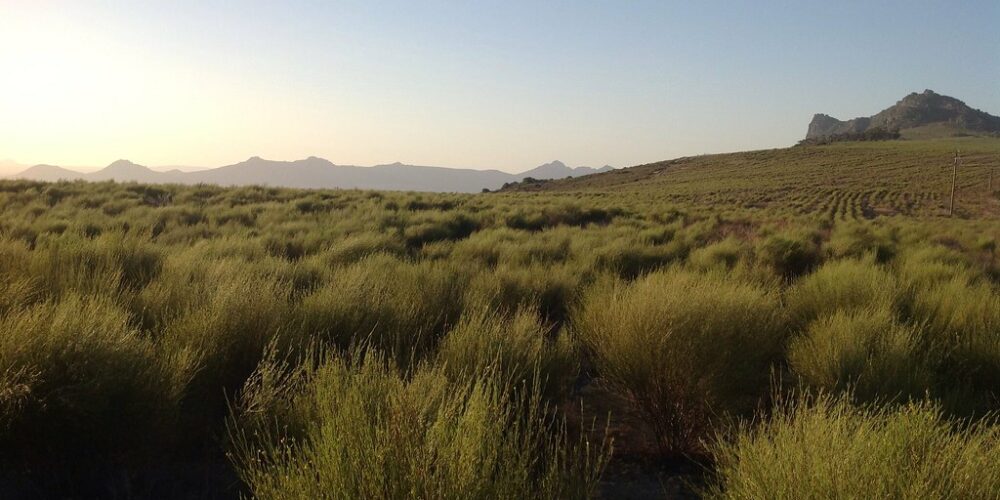
This is the Cederberg – a wilderness of dramatic sandstone formations, fynbos-covered slopes, and dry river valleys about three hours north of Cape Town. It is harsh, beautiful, and utterly unique. And without it, there would be no rooibos.
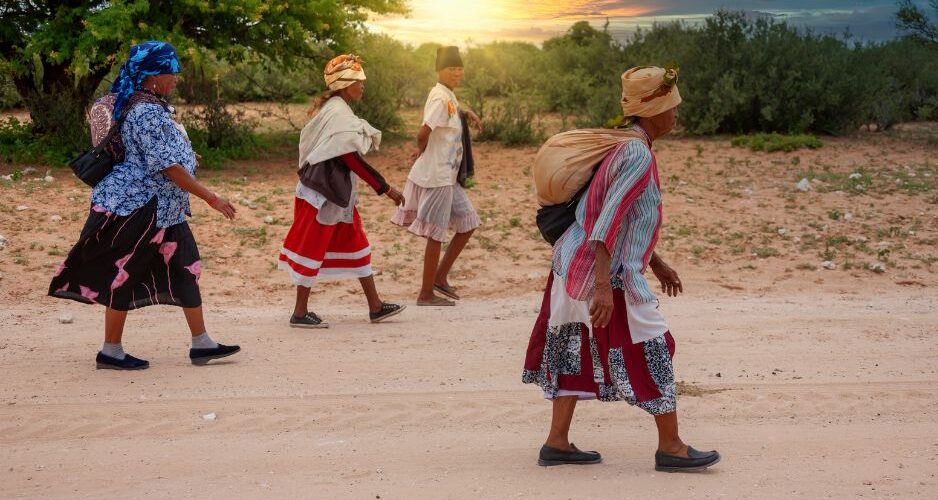
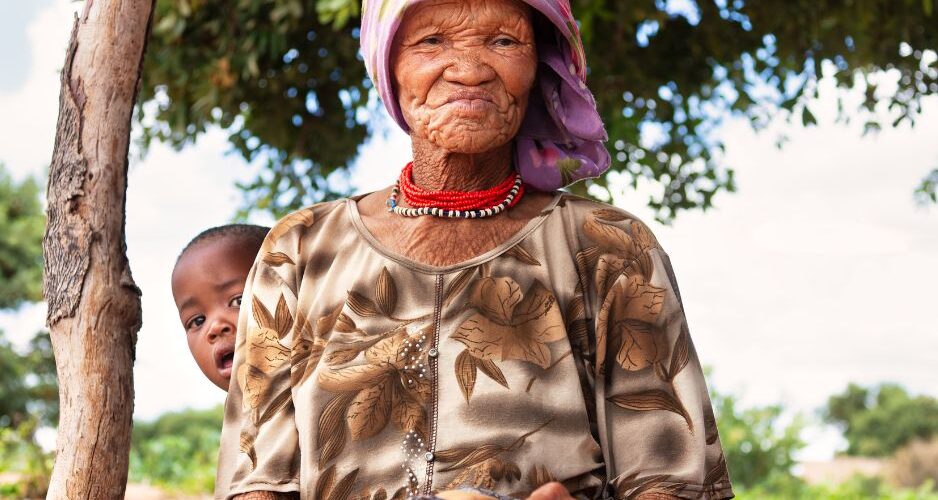
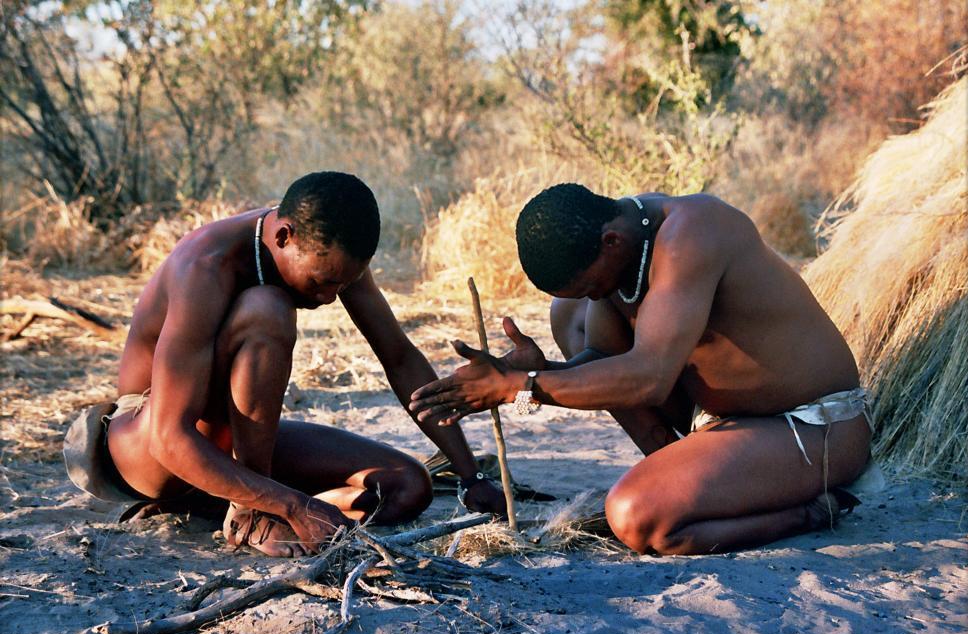
But the rooibos tea origin does not begin with a botanist or a tea merchant. It begins with the Khoisan – the indigenous people of southern Africa who have called this landscape home for longer than almost any other group of humans has lived anywhere on Earth.
Table of contents
Who Are the Khoisan?
The name Khoisan brings together two distinct but related peoples: the Khoi (also called Khoikhoi) and the San. Together, they are considered among the oldest continuous populations in human history.
Genetic research suggests their lineage diverged from other human groups over 100,000 years ago – making them a living link to the very earliest chapter of our species.
The name itself comes from their own languages. Khoi means “person,” and San means “forager” – so Khoisan translates loosely as “people who forage in the bush.”
For tens of thousands of years, that is exactly what they did: reading the landscape, understanding plants, and surviving in some of the most demanding terrain on the continent.
One of the most distinctive features of Khoisan languages is their use of click consonants – a feature so unusual to outside ears that early European settlers often struggled to transcribe or even represent the sounds.
These clicks are not decorative; they are full, meaning-carrying phonemes, woven into the grammar of languages that evolved entirely separately from the Indo-European family.
Despite their extraordinary cultural and genetic heritage, the Khoisan have faced centuries of displacement, land loss, and marginalisation – first under Dutch colonial rule from the 17th century, then under British colonialism, and later under apartheid.
Many communities were pushed off their ancestral lands and stripped of legal recognition. That history matters when we talk about rooibos, because the knowledge that turned a wild shrub into a beloved beverage was theirs first.
A Plant That Only Grows Here
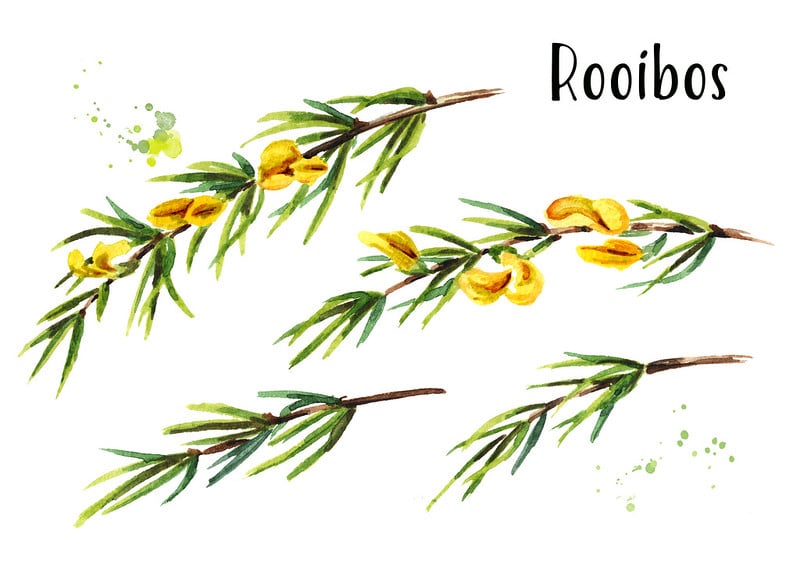
The rooibos shrub – Aspalathus linearis – is one of approximately 9,000 plant species that make up the Cape Floristic Region, one of the world’s six recognised floral kingdoms and one of the most biodiverse places on the planet.
More plant species grow in the Cape Floristic Region than in the entire United Kingdom – packed into a comparatively tiny strip of land at Africa’s southern tip.
Within that region, rooibos is even more particular. It grows almost exclusively in the Cederberg mountains and the surrounding Sandveld lowlands – a zone spanning roughly 200 kilometres.
Attempts to cultivate it elsewhere have largely failed. Australia, China, Japan, the United States, and Namibia have all tried. None have succeeded in any meaningful commercial sense.
The reason comes down to a very specific set of conditions that this plant has spent millennia adapting to:
| Condition | What rooibos needs | Why it matters |
|---|---|---|
| Soil | Nutrient-poor, highly acidic, iron-rich sandy soils | Most crops would fail here - rooibos thrives precisely because of it |
| Climate | Mediterranean-type: cool wet winters, long hot dry summers | One of very few regions on Earth with this exact pattern |
| Altitude | Roughly 450 to 1,500 metres in the mountains; lower Sandveld farms also produce it | Elevation shapes the character of the leaf and the flavour in the cup |
| Fire ecology | Periodic burning as part of the natural fynbos cycle | Rooibos evolved alongside fire - some farmers use controlled burns to mirror this rhythm |
This is not simply a plant with a preference for certain conditions. Rooibos is, in a genuine ecological sense, a product of this specific place – and nowhere else.
The Khoisan and the Red Bush
The Khoisan did not “discover” rooibos in the way a scientist might classify a specimen. They simply knew it – as they knew the rest of their landscape – through generations of accumulated observation, passed down without written records.
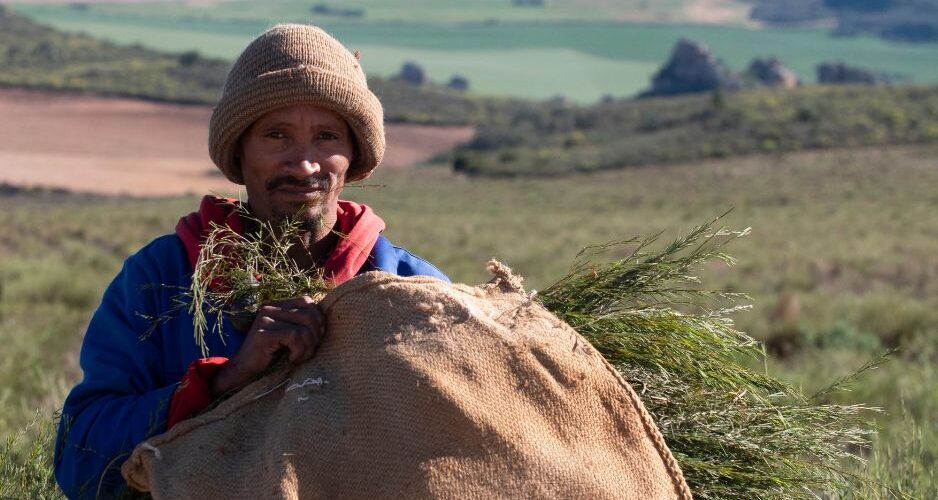
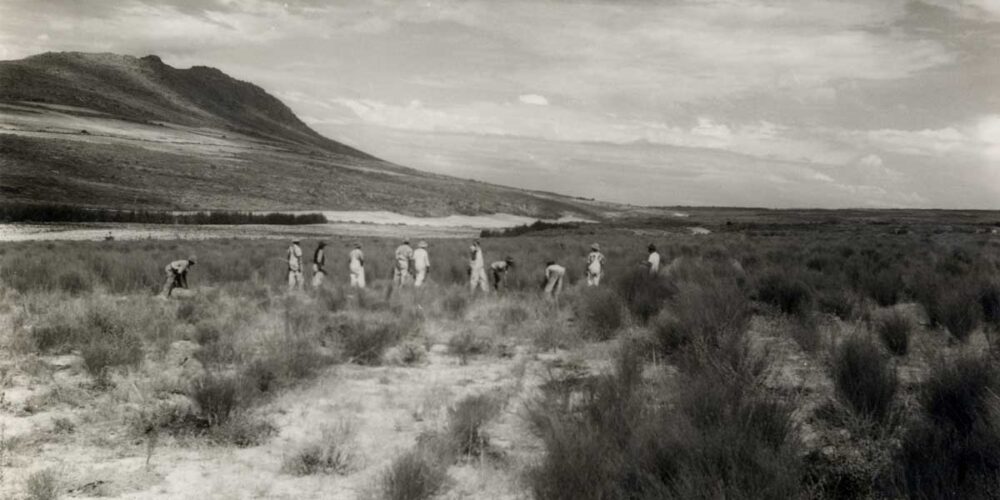
They harvested the needle-like leaves and stems, bruised them with stones or sticks, allowed them to ferment in the sun, and brewed the resulting material as a medicinal tea.
The beverage was used for stomach ailments, skin conditions, allergies, and as a general tonic. Mothers gave it to colicky infants. Elders drank it for its calming properties.
This was not folk medicine in the dismissive sense that term sometimes implies. It was a sophisticated, field-tested body of botanical knowledge developed over a very long time.
What we now call “antioxidants” or “aspalathin” – the compounds that modern research identifies as beneficial – were simply properties the Khoisan had observed in practice, long before the language of biochemistry existed.
European settlers in the Cape gradually learned about rooibos from Khoisan communities, and by the 18th century it was being used more widely as an affordable substitute for imported black tea, which was expensive and difficult to obtain in the remote interior.
The Botanist Who Listened
The leap from local knowledge to commercial crop required someone willing to pay attention to what the Khoisan already knew.
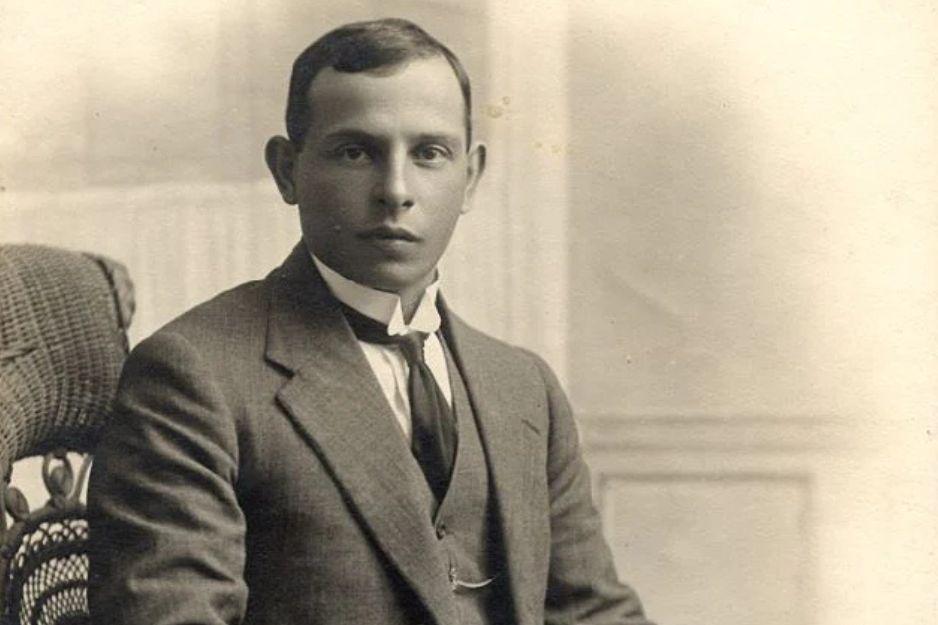
In 1904, a Russian botanist and entrepreneur named Benjamin Ginsberg began trading rooibos – partly by learning harvesting techniques directly from Khoisan communities in the Cederberg.
He is often credited as the first to commercialise the tea, though it is important to acknowledge that the knowledge base he drew upon was not his own.
Benjamin Ginsberg
The Rooibos Pioneer
The next critical figure was Dr Pieter le Fras Nortier, a local doctor who in the 1930s began serious attempts to cultivate rooibos from seed rather than relying solely on wild harvesting.
He, too, worked alongside Khoisan community members – in particular, a woman named Elsie Doelman, who is said to have known where rooibos seeds could be found and how to collect them effectively.
Her contribution is rarely mentioned in formal histories of the tea, but without her knowledge, Nortier’s cultivation experiments might never have succeeded.
By the mid-20th century, commercial rooibos farming was established in the Cederberg. Today, the industry produces around 15,000 to 20,000 tonnes of dried rooibos per year, with the majority exported to Germany, the Netherlands, Japan, the UK, and the United States.
The Khoisan communities whose ancestors originated and sustained that knowledge for generations received very little in return for a very long time.
A Question of Recognition
That is slowly, partially changing.
In 2019, the South African government passed the Traditional and Khoi-San Leadership Act, which provided formal legal recognition to Khoisan communities and their leadership structures – a significant step after centuries of exclusion from official governance.
Separately, rooibos was granted Protected Designation of Origin (PDO) status by South Africa in 2021, legally confirming that only tea grown in the designated Cederberg and Sandveld region can be called rooibos.
This mirrors the kind of geographic protection enjoyed by products like Champagne or Parmigiano-Reggiano.
Alongside that designation, a benefit-sharing agreement was established that directs a percentage of the value of rooibos sold to Khoisan and other local communities. It is a beginning, even if the amounts involved remain modest relative to the scale of the industry.
These developments matter – not just as policy, but as an acknowledgement that the story of rooibos is inseparable from the story of the people who first understood it.
The Cederberg Today
The mountains themselves are worth understanding, because they shape the tea in ways that are almost impossible to replicate.
The Cederberg Wilderness Area is a UNESCO Biosphere Reserve, a protected landscape of around 71,000 hectares. Its sandstone formations – some of the oldest rock on Earth – have been sculpted by wind and water into extraordinary shapes: arches, needles, and towers that turn amber and red at dusk.
Rock art left by San communities covers many of these surfaces – some of the finest examples of ancient human art in the world, depicting hunting, ritual, and spiritual life in pigments that have endured for thousands of years.
The fynbos that covers the slopes is extraordinary in its own right. “Fynbos” is an Afrikaans word meaning “fine bush,” and it refers to the characteristic shrubby, fine-leaved vegetation of the Cape.
It is one of the most species-rich plant communities on the planet – and rooibos is simply one member of a vast botanical community that has evolved together over millions of years.
Rooibos farms in this landscape tend to be family operations, often multi- generational, working within a tight ecosystem that rewards careful land management.
The plants take two to three years to reach harvestable maturity, and are cut by hand – typically in the summer months of January and February – using a small sickle.
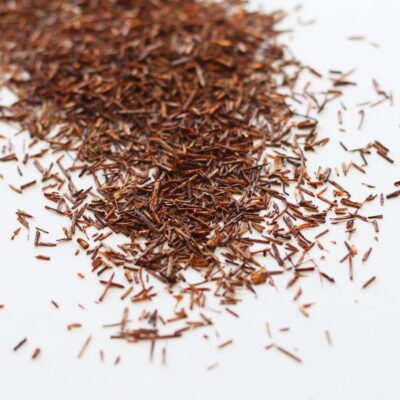
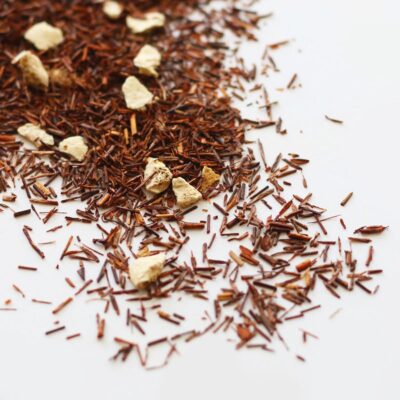
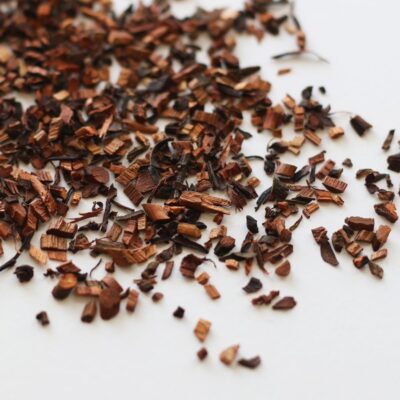
The harvested material is bruised, moistened, and laid out to oxidise in the sun, which triggers the enzymatic reactions that turn the green needle-like leaves into the familiar reddish-brown tea.
A Brief Word on Honeybush
No account of southern Africa’s indigenous teas would be complete without mentioning honeybush – rooibos’s lesser-known neighbour.
Also native to the Cape Floristic Region, honeybush (Cyclopia species) grows in a slightly different zone – primarily the eastern and southern Cape – and produces a naturally sweet, mildly floral tea with a distinctive honey-like aroma that gives it its name.
Like rooibos, it is caffeine-free, rich in antioxidants, and has a long history of use among local communities.
While honeybush has not achieved the same global profile as rooibos, it is increasingly attracting attention from specialty tea buyers and wellness consumers.
Some producers are also experimenting with blending the two, which produces a cup with the earthiness of rooibos softened by honeybush’s natural sweetness.
Both teas are expressions of the same extraordinary landscape – and both carry the same story of indigenous knowledge that long preceded their commercial existence.
What This Means When You Brew a Cup
There is a temptation, when drinking any tea, to think of it as a product: something that arrived in a package, to be steeped and consumed. But rooibos resists that reduction more than most.
Every cup contains the chemistry of a specific iron-rich soil. It carries the influence of a Mediterranean climate that exists in very few places on Earth. It reflects a harvesting and processing tradition developed over centuries by people who read that landscape more intimately than almost anyone has read anything.
And it carries the knowledge of the Khoisan – people whose history in that place stretches back further than written records, whose understanding of its plants and its rhythms was accumulated over a span of time that makes the modern tea industry look very young indeed.
Knowing that does not change the flavour. But it changes what the flavour means.
Frequently asked questions
Rooibos tea originates from the Cederberg mountains in South Africa, a remote wilderness about three hours north of Cape Town. The indigenous Khoisan people were the first to harvest and brew the plant, using it as a medicinal tea long before it became a commercial product.
Rooibos (Aspalathus linearis) requires a very specific combination of conditions: nutrient-poor, highly acidic, iron-rich sandy soils; a Mediterranean climate with cool wet winters and long hot dry summers; altitudes between 450 and 1,500 metres; and a natural fire ecology. This unique set of conditions exists almost exclusively in the Cederberg and Sandveld region. Countries including Australia, China, Japan, the United States, and Namibia have all tried to cultivate rooibos without meaningful commercial success.
The Khoisan are the indigenous people of southern Africa and among the oldest continuous populations in human history — genetic research suggests their lineage diverged from other human groups over 100,000 years ago. They are the original discoverers and users of rooibos, harvesting the leaves, fermenting them in the sun, and brewing the tea for medicinal purposes including stomach ailments, skin conditions, and as a general tonic. The knowledge that eventually became the commercial rooibos industry was first developed and held by the Khoisan.
Yes. Rooibos is naturally caffeine-free, which is one of the reasons it has long been used by Khoisan mothers for colicky infants and by people seeking a calming drink at any time of day.
‘Rooibos’ is an Afrikaans word meaning ‘red bush,’ which refers to the reddish-brown colour the plant’s needle-like leaves turn after they are harvested, bruised, moistened, and left to oxidise in the sun. The botanical name for the rooibos plant is Aspalathus linearis.
In 1904, Russian botanist and entrepreneur Benjamin Ginsberg began trading rooibos commercially, drawing on harvesting knowledge from Khoisan communities in the Cederberg. In the 1930s, Dr Pieter le Fras Nortier began cultivating rooibos from seed, working alongside Khoisan community members — including a woman named Elsie Doelman, whose knowledge of where to find and collect rooibos seeds proved essential. By the mid-20th century, commercial farming was fully established in the region.
In 2021, rooibos was granted Protected Designation of Origin status by South Africa, which legally confirms that only tea grown in the designated Cederberg and Sandveld region can be called rooibos. This is similar to the geographic protections enjoyed by products such as Champagne or Parmigiano-Reggiano. Alongside this, a benefit-sharing agreement was established to direct a percentage of rooibos sales revenue to Khoisan and local communities.
Rooibos contains antioxidants — including a compound called aspalathin that is unique to the plant — which modern research has identified as potentially beneficial. The Khoisan used it for centuries to treat stomach ailments, skin conditions, allergies, and as a general tonic. It is also naturally caffeine-free and low in tannins. While we are a tea company rather than a medical authority, the long history of traditional use and growing body of research both point to rooibos as a naturally healthful choice.
Rooibos plants take two to three years to reach harvestable maturity. They are cut by hand — typically in January and February — using a small sickle. The harvested material is then bruised, moistened, and laid out in the sun to oxidise. This process triggers enzymatic reactions that turn the green needle-like leaves into the familiar reddish-brown tea. The same fundamental method has been used for centuries.
Both are indigenous, caffeine-free teas from South Africa’s Cape Floristic Region, but they come from different plants and grow in different areas. Rooibos (Aspalathus linearis) grows primarily in the Cederberg and Sandveld. Honeybush (Cyclopia species) grows mainly in the eastern and southern Cape and produces a naturally sweeter, mildly floral cup with a honey-like aroma. Some producers blend the two, combining the earthiness of rooibos with honeybush’s natural sweetness.
The Cederberg is a wilderness area about three hours north of Cape Town, covering around 71,000 hectares and recognised as a UNESCO Biosphere Reserve. Its ancient sandstone formations, fynbos-covered slopes, and highly specific soil and climate conditions are what make rooibos possible. It is also home to thousands of years of San rock art. Understanding the Cederberg is inseparable from understanding rooibos — the tea is, in a genuine ecological sense, a product of that specific place.
At Teapro, we believe that understanding where tea comes from – its land, its people, its history – is part of learning to truly taste it. Our pure, single-origin rooibos is sourced without artificial sweeteners, because the real thing, from the real place, needs nothing added.

Teapro co-founder. Favourite tea - Long Jing Dragon Well Green Tea. Obsessed with film, photography and travelling.
- Tatjana



chaline church
Posted at 21:26h, 09 OctoberAspalathus carnosa is a plant I believe and not a beetle. I believe Rooibos is pollinated by several bee types and wasps. Can you share the link you have to validate the info that Rooibos is pollinated by the “Aspalathus carnosa” beetle as I believe you may wrong here.
Tatjana
Posted at 10:42h, 11 OctoberThank you so much for pointing it out – I double checked and you’re right. I will fix this section in the article.