13 Aug Jasmine and Green Tea: The Complete Guide to Benefits, Caffeine Content, Taste and More
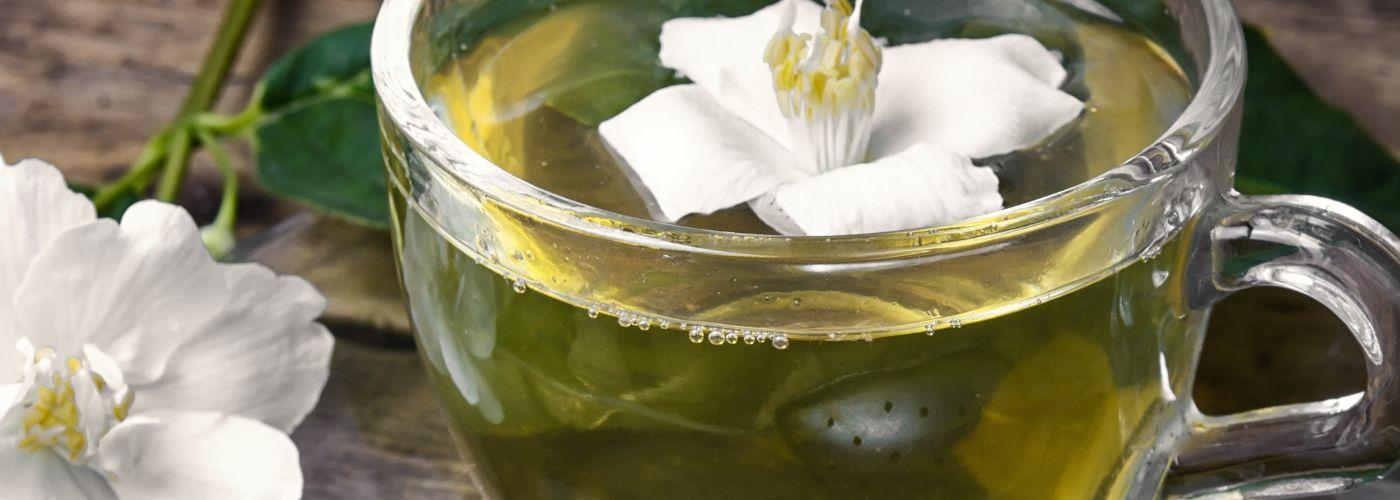
Jasmine and green tea are more closely linked than most people realise, in fact, “jasmine tea” quietly covers two genuinely different drinks wearing the same name.
This guide untangles that from the start, then covers everything else worth knowing: the real health benefits behind the research, how much caffeine actually ends up in your cup, what jasmine green tea tastes like next to plain green tea, and a few honest caveats worth having before you brew your next pot.
Table of Contents
Jasmine Tea vs Jasmine Green tea: Two different drinks
How does Green tea get its Jasmine flavour?
Does Jasmine tea have caffeine?
How much caffeine is in Jasmine tea?
What does Jasmine tea taste like?
Jasmine tea vs Green tea: What’s the difference?
Jasmine tea health benefits
Jasmine tea for relaxation
Is Jasmine tea good for weight loss?
Jasmine tea during pregnancy
Jasmine tea side effects
How to brew Jasmine tea properly
Frequently asked questions
Final thoughts
Jasmine Tea vs Jasmine Green Tea: Two Different Drinks
The phrase “jasmine tea” gets used loosely, and it genuinely covers two different drinks that are worth telling apart before going any further.
Getting this distinction right matters, because they don’t share the same caffeine content, the same production method, or, in the strictest sense, the same right to be called “tea” at all.
| Jasmine (Flower) Tea | Jasmine Green Tea | |
|---|---|---|
| What it actually is | Dried jasmine blossoms only, no tea leaf at all | Green tea leaves scented with fresh jasmine blossoms |
| Technically a "tea"? | No, it's a herbal tisane, since it contains no Camellia sinensis leaf | Yes, it's a true tea, since the base is genuine green tea leaf |
| Caffeine | None | Yes, roughly 25 to 40mg per cup, in line with plain green tea |
| Flavour | Purely floral and delicate, closer to a flower infusion than a tea | Grassy, vegetal green tea character with a floral, lightly sweet aroma layered on top |
| What most people buy | Less common, usually labelled clearly as jasmine flower tea or jasmine buds | The vast majority of what's sold simply as "jasmine tea", including jasmine pearls |
Strictly speaking, jasmine (flower) tea is the one that’s genuinely “jasmine tea”, just dried jasmine blossoms, steeped on their own as a caffeine free tisane.
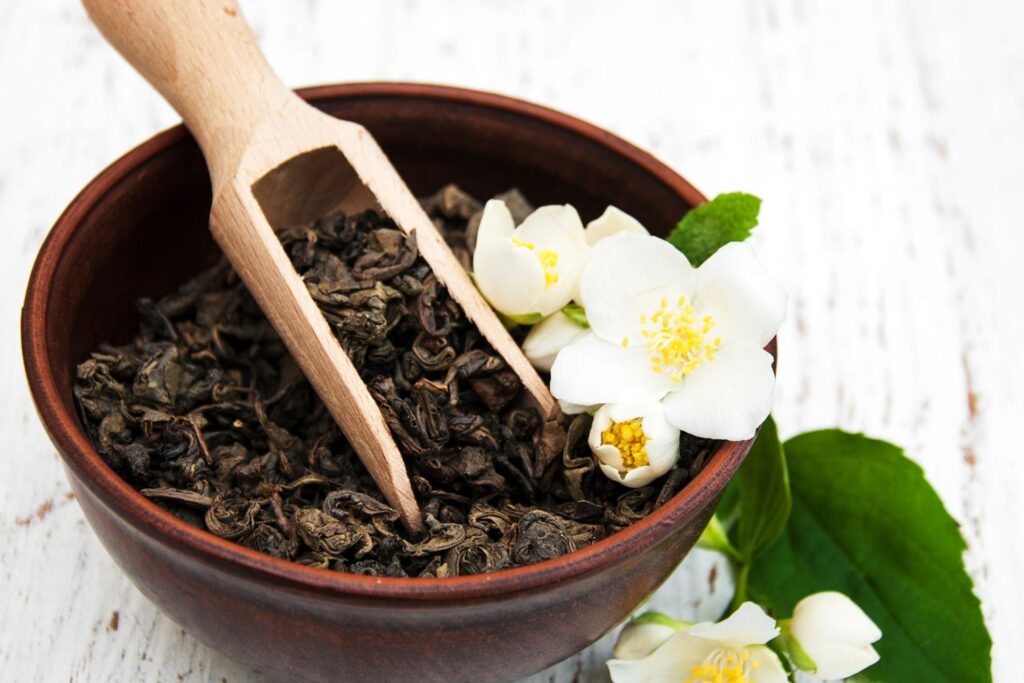
What most people mean, and what most of this guide covers, is jasmine green tea, green tea leaves that have absorbed jasmine’s aroma through a scenting process, then usually had the spent flowers removed again.
Both are entirely genuine products worth knowing, they’re simply not the same drink, and shouldn’t be assumed to share the same caffeine content or benefits.
A cup of jasmine (flower) tea steeped on its own also tends to taste and smell noticeably milder than jasmine green tea, since it’s the slow, repeated scenting process, layering fresh flowers with tea leaves over several rounds, that builds up jasmine green tea’s deep, lasting aroma.
Steeped alone for just a few minutes, the flowers simply don’t have time to release anywhere near as much fragrance.
How Does Green Tea Get Its Jasmine Flavour?
Jasmine flavour is added through a process called scenting, layering fresh jasmine blossoms with tea leaf so the leaf absorbs their aroma, rather than through any flavouring added during growing or processing.
While jasmine can technically be used to scent white, oolong or even black tea, the vast majority of jasmine tea on the market, including well known styles like jasmine pearls, uses a green tea base.
Unless a product specifically states otherwise, jasmine green tea shares plain green tea’s caffeine content and antioxidant profile rather than being a separate category of its own.
There is also a second distinction worth knowing, since not all jasmine green tea is made the same way.
Traditional scenting works by layering fresh jasmine blossoms with the tea leaf overnight, so the leaf absorbs the flowers’ aroma.
What happens next varies by producer:
| Scenting Method | How It's Made |
|---|---|
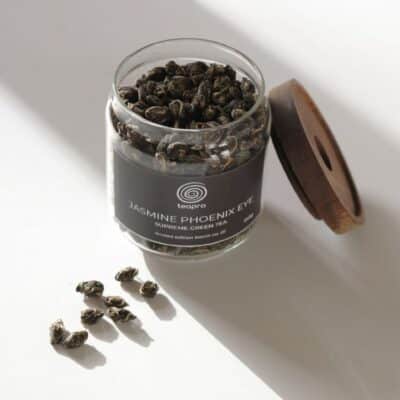
| Jasmine-Scented Green Tea (Flowers Sifted Out) | Once the leaf has fully absorbed the aroma, the spent jasmine blossoms are sifted out and discarded, since their job (transferring fragrance) is already done. Only the scented leaf remains in the finished tea. Teapro's Phoenix Eye Jasmine Green Tea is made this way, hand-rolled green tea pearls are layered with fresh jasmine blossoms overnight, then sifted and dried, a process repeated up to seven times, with no flowers left in the final tea. |
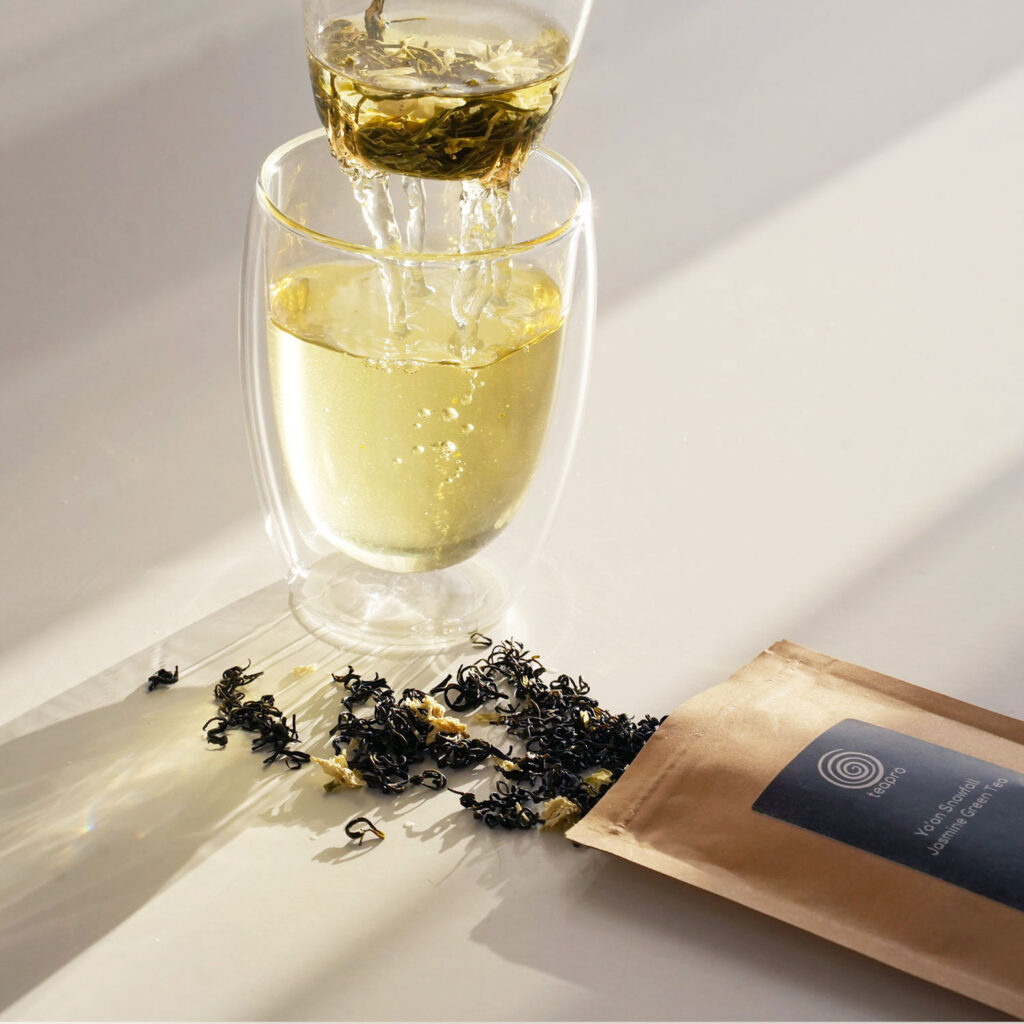
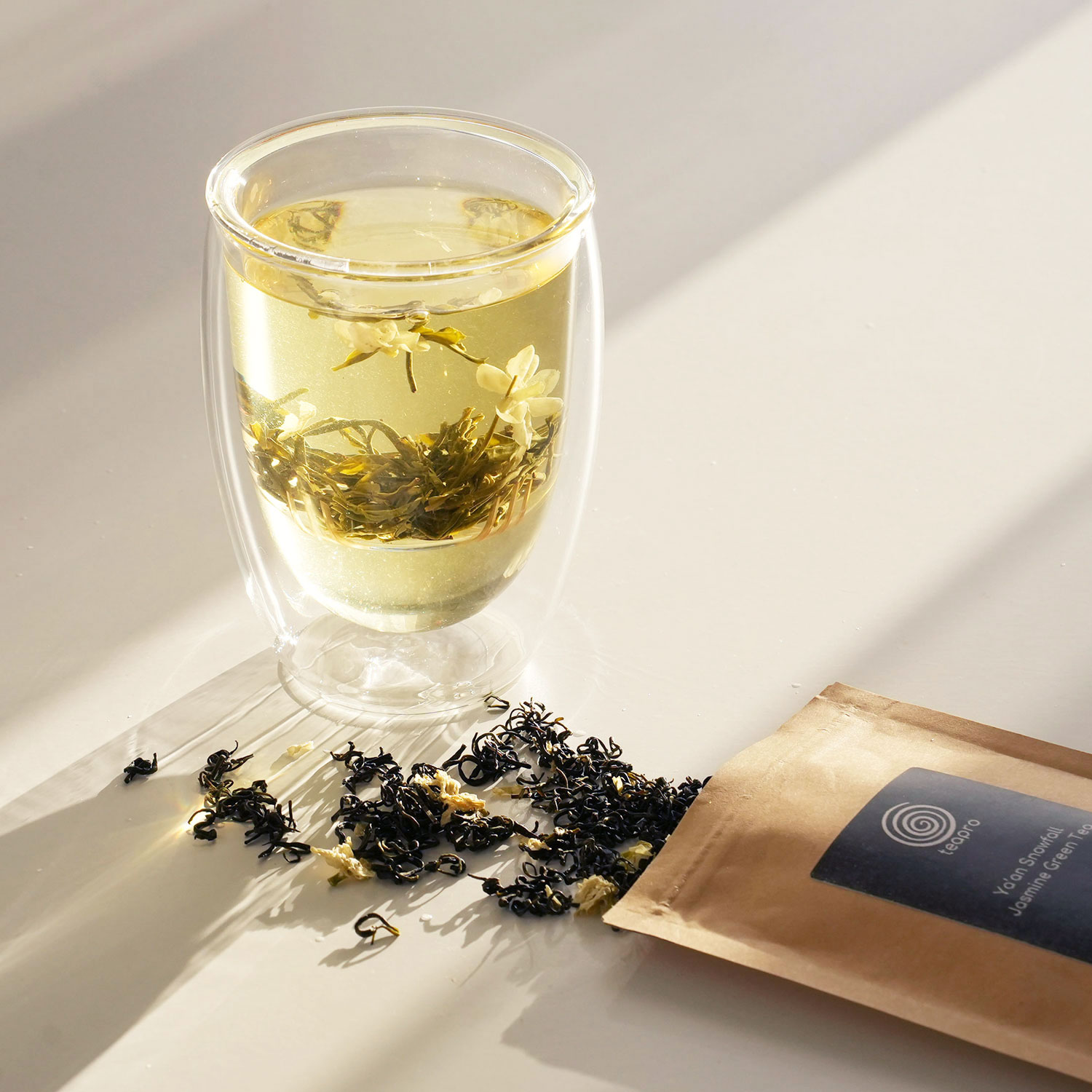
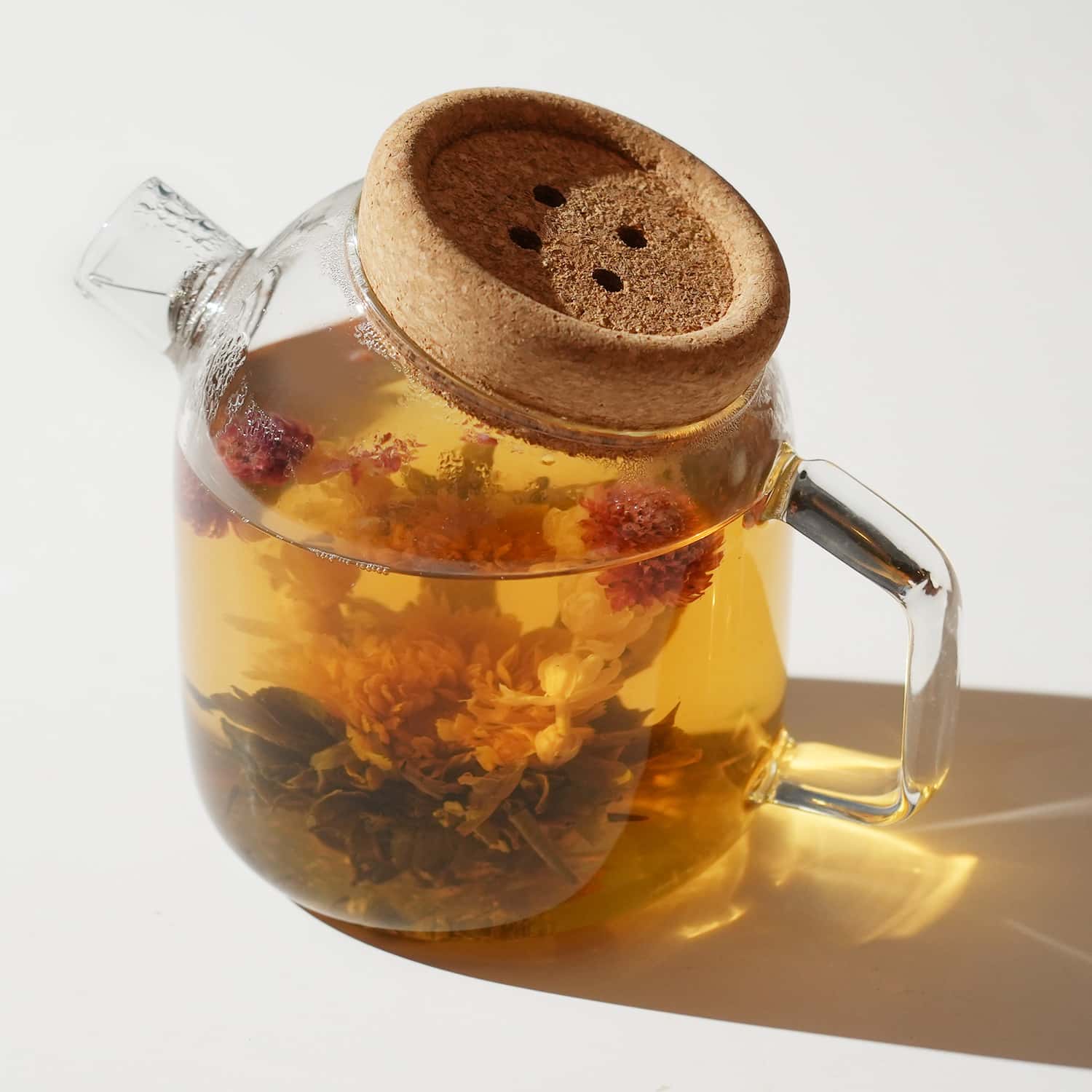
| Jasmine Green Tea With Real Flowers Left In | Some producers finish the tea with a small number of jasmine blossoms mixed back in after scenting, purely for aroma and visual character rather than function. Teapro's Ya'an Snowfall Jasmine Green Tea follows the same scenting process, but a select few jasmine petals are left in the finished leaf, so you will genuinely see and steep real flowers alongside the tea. |
Does this affect the benefits? Not meaningfully in terms of caffeine or antioxidant content, both come from the tea leaf itself, not the flowers.
Where it can make a difference is the aroma experience, since real flower petals steeping alongside the leaf may offer a more direct, lingering floral aroma in the cup.
The calming effect linked to jasmine’s scent (covered below) comes from inhaling that aroma, so a cup with real petals in it is arguably closer to the source.
That said, this is a sensory distinction rather than a proven difference in health outcome, both styles are genuinely jasmine green tea, just crafted with a different finishing step.
Either way, both remain distinct from jasmine (flower) tea, which contains no tea leaf at all.
Does Jasmine Green Tea Have Caffeine?
Yes. Despite its delicate, floral character, jasmine tea does contain caffeine, because the caffeine comes from the tea leaf itself, not the jasmine flowers.
The blossoms add aroma and a light natural sweetness, nothing more, so if the base is a true tea (green, white, oolong or black), caffeine comes along with it.
This is precisely where jasmine (flower) tea differs, since it contains no tea leaf at all, it contains no caffeine either.
How Much Caffeine Is in Different Jasmine Teas?
How much caffeine in Jasmine tea depends entirely on which tea leaf was used as the base:
| Jasmine Tea Type | Caffeine Content |
|---|---|
| Jasmine Green Tea | The most common style, typically around 25 to 40mg of caffeine per 240ml cup, broadly in line with plain green tea. |
| Jasmine White Tea | The lowest caffeine true tea option, usually under 20mg per cup, thanks to its minimal processing. |
| Jasmine Oolong Tea | Sits in the middle, typically 30 to 40mg per cup. |
| Jasmine Black Tea | The highest caffeine option, typically 40 to 50mg per cup. |
| Herbal Jasmine Tisane | Genuinely caffeine free, but technically not tea at all, since it is made purely from jasmine flowers or a caffeine-free herbal base like rooibos rather than Camellia sinensis leaves. |
For comparison, a standard cup of filter coffee contains roughly 95mg of caffeine, so even the strongest jasmine black tea sits at well under half that amount, and jasmine (flower) tea sits at none at all.
What Does Jasmine Green Tea Taste Like?
Jasmine green tea tastes floral and lightly sweet, with the grassy, vegetal character of its green tea base sitting underneath a delicate, perfumed aroma.
Good quality jasmine green tea should never taste soapy or overly perfumed, that usually points to lower grade tea scented too aggressively or with artificial flavouring rather than genuine jasmine blossoms.
Done well, the floral note is subtle and balanced rather than overpowering, with a smooth, slightly creamy mouthfeel and a naturally sweet finish.
Jasmine green teas that keep real petals in the leaf, such as Teapro’s Ya’an Snowfall, often have a fuller, more lingering floral character than styles where the spent flowers are fully sifted out.
Jasmine (flower) tea, by contrast, tastes exactly like what it is: purely floral, light and delicate, without the grassy green tea backbone underneath.
It’s closer to drinking a flower infusion than a tea in the traditional sense, gentler and simpler, with none of the vegetal depth that jasmine green tea carries.
Jasmine Green Tea vs Green Tea: What’s the Difference?
Since jasmine green tea is a green tea base to begin with, jasmine green tea vs green tea comes down to scenting rather than a fundamentally different tea.
Plain green tea offers a grassy, vegetal, sometimes savoury flavour straight from the leaf, while jasmine green tea takes that same base and layers in a floral, lightly sweet aroma from the blossoms.
Caffeine content and antioxidant profile are effectively the same between the two, so the real difference comes down to taste and aroma.
Jasmine green tea suits anyone who finds plain green tea a little too grassy and wants something more fragrant and forgiving, while plain green tea suits those who want the cleanest, most unflavoured expression of the leaf itself.
Jasmine Green Tea Health Benefits
Because jasmine green tea is built on a green tea base, most of its benefits are shared with green tea generally, with the jasmine scenting itself contributing a few benefits of its own.
| Benefit | What the Research Says |
|---|---|
| Rich in Antioxidants | Green tea, and therefore jasmine green tea, is a strong source of catechins, including EGCG, a group of antioxidants that have been widely studied for their potential role in supporting general wellbeing as part of a balanced diet. |
| Calm, Steady Focus | The combination of L-theanine and a moderate amount of caffeine is associated with a calmer, more sustained kind of alertness than coffee, without the same crash. |
| A Genuinely Researched Calming Aroma | This is the one benefit unique to jasmine specifically, and it's shared by jasmine green tea and jasmine (flower) tea alike, since it comes from the scent itself. A peer-reviewed study published in the European Journal of Applied Physiology found that inhaling the aroma of jasmine tea produced measurable decreases in heart rate and more calm, positive mood states in healthy volunteers, an effect the researchers linked to linalool, one of the aroma compounds in jasmine blossoms. |
| Supports Oral Health | Green tea's catechins have been studied for their potential to inhibit certain bacteria in the mouth, traditionally associated with fresher breath as part of good oral hygiene. This benefit is specific to jasmine green tea's tea leaf content, and doesn't apply to caffeine free jasmine (flower) tea in the same way. |
These are general wellbeing associations rather than medical claims, and jasmine green tea should be enjoyed as part of an overall varied, balanced diet rather than as a treatment for any health condition.
Jasmine Green Tea for Relaxation
Jasmine tea for sleep and relaxation is a popular search, and it’s one of jasmine’s genuinely well-supported benefits, covered in more detail above.
The aroma itself is where this benefit lives.
So many people enjoy the ritual as an evening wind-down, choosing a lighter, shorter steep of jasmine green tea in the evening, or switching to caffeine free jasmine (flower) tea if sleep quality is a particular priority, since it offers the same calming aroma without any caffeine to weigh against it.
Teapro Black Label Ya’an Snowfall Jasmine Green Tea | Limited Edition
Teapro Black Label Supreme Phoenix Eye Jasmine Green Tea | Limited Edition
Is Jasmine Green Tea Good for Weight Loss?
Jasmine tea for weight loss is another frequently searched question, and it deserves an honest answer: no single tea, jasmine included, is a proven weight loss solution.
Green tea, and by extension jasmine green tea, contains catechins and a moderate amount of caffeine, both of which have been studied for a potential, modest role in metabolism, but this effect is small and works best, if at all, alongside an overall balanced diet and active lifestyle, not as a substitute for either.
Caffeine free jasmine (flower) tea contains no catechins from tea leaf at all, so this modest association doesn’t apply to it in the same way.
Jasmine Green Tea During Pregnancy
Is jasmine green tea safe during pregnancy?
In moderation, most people can enjoy it, but since it typically contains a moderate amount of caffeine, it’s worth counting towards your total daily intake and checking with your midwife or doctor for guidance specific to you.
A caffeine free jasmine (flower) tea is a reasonable alternative if you would like the flavour without the caffeine question at all, though it’s still worth checking any herbal tisane with your midwife or doctor during pregnancy, since not every herbal ingredient is automatically considered safe.
For more detail on how caffeine and tea fit into pregnancy more broadly, our complete guide to green tea during pregnancy covers the same considerations, since jasmine green tea is typically a scented green tea at its base.
Jasmine Green Tea Side Effects
Jasmine green tea is well tolerated by most people, but a few things are worth knowing.
Because it contains caffeine, drinking it in excess can cause the same effects as any caffeinated drink, restlessness, disrupted sleep or an upset stomach, particularly on an empty stomach.
Jasmine green tea is naturally low in acidity compared to coffee, but very sensitive individuals may still notice mild digestive discomfort.
As with any tea, moderation is key, and anyone with specific health conditions or on medication should check with a doctor or pharmacist before making it a daily habit.
Caffeine free jasmine (flower) tea avoids the caffeine-related side effects entirely, though as with any herbal tisane, it’s worth checking for any personal sensitivities.
How to Brew Jasmine Green Tea Properly
Getting the most from jasmine green tea, in flavour and aroma, comes down to gentle brewing.
Use water around 75 to 80°C rather than boiling, since overly hot water scorches the delicate leaves and mutes the floral aroma.
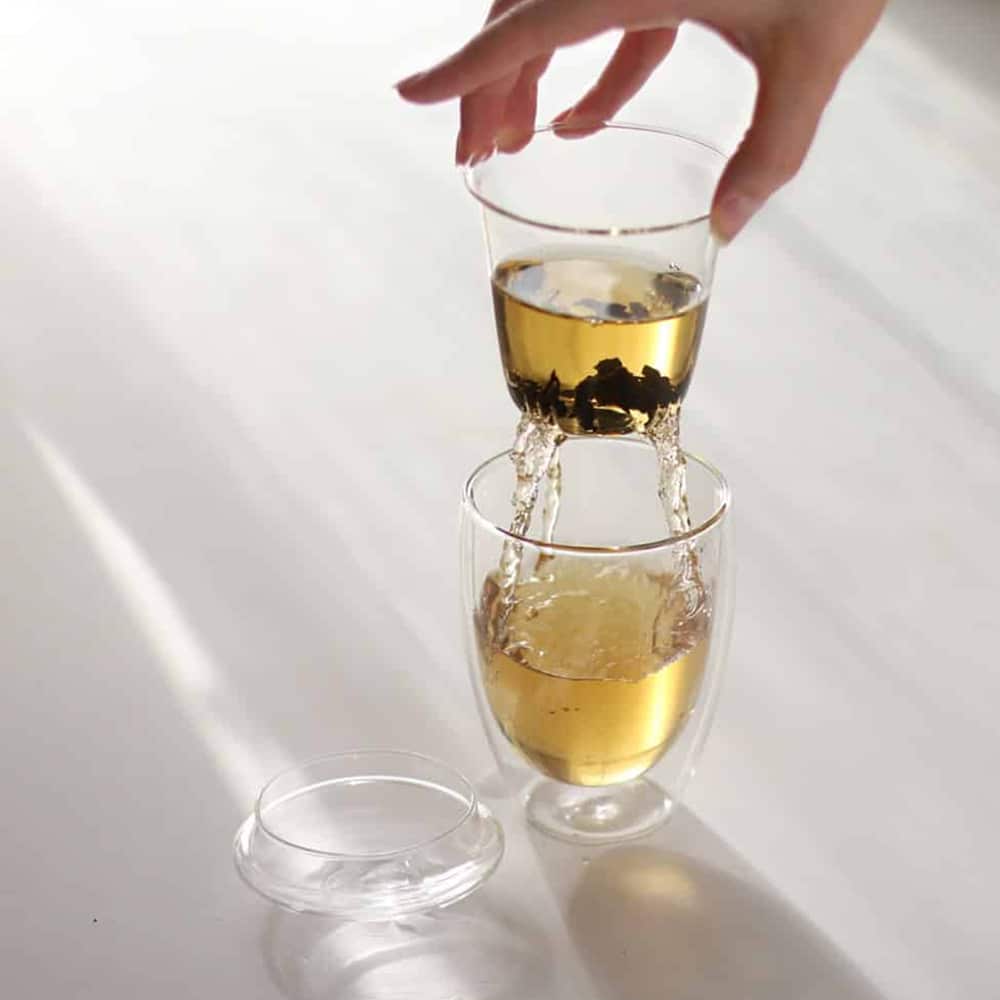
Steep for 2 to 3 minutes, and use good quality, whole leaf jasmine green tea, such as jasmine pearls, rather than dusty, broken leaf bags, which lose their fragrance far more quickly.
Jasmine (flower) tea is more forgiving.
Since there’s no delicate green tea leaf to protect, it can handle fully boiled water and a slightly longer steep, around 4 to 5 minutes, to draw out as much of its floral character as possible.
For a full breakdown of green tea types, origins and step-by-step brewing guidance, read our complete guide to Green Tea
Frequently asked questions
Jasmine green tea offers the same general antioxidant and L-theanine benefits as green tea, along with a genuinely researched calming effect from its aroma, which has been shown in peer-reviewed studies to lower heart rate and support a calmer mood state.
Enjoyed as part of a balanced diet, jasmine green tea can be a satisfying, low-calorie source of antioxidants and a naturally calming daily ritual. As with any tea, moderation is key.
Jasmine green tea’s antioxidant catechins, inherited from its green tea base, are often studied for their potential to help protect skin cells from everyday environmental stress. Drinking it supports this from within, though topical skincare products work differently.
Not exactly, but they are closely related. Jasmine tea is usually a green tea base that has been scented with jasmine blossoms, so it shares green tea’s antioxidants, with an added floral aroma and flavour.
Jasmine green tea tastes floral and lightly sweet, with the grassy, vegetal character of green tea underneath. Done well, it should taste delicate and balanced, never soapy or artificially perfumed.
Yes. Real jasmine green tea is scented green tea, so it naturally contains a moderate amount of caffeine, typically 25 to 40mg per cup, roughly a third of a filter coffee. Only pure jasmine (flower) tea, made from blossoms alone, is genuinely caffeine free.
Jasmine green tea usually contains a moderate amount of caffeine, so it should be enjoyed in moderation during pregnancy. Speak with your midwife or doctor about what’s right for you, or choose a caffeine free jasmine (flower) tea instead.
The aroma of jasmine has genuine research behind its calming effect, making it a popular evening ritual. For a caffeine-free evening cup, choose jasmine (flower) tea instead of jasmine green tea.
Not necessarily. “Jasmine tea” strictly refers to dried jasmine blossoms steeped on their own, a caffeine free herbal tisane with no tea leaf involved. “Jasmine green tea” is green tea leaves scented with jasmine blossoms, and it’s what most people actually mean when they casually say “jasmine tea”.
Final Thoughts
Jasmine and green tea come down to one simple fact worth remembering: “jasmine tea” is really two different drinks wearing the same name.
Jasmine (flower) tea is the true, caffeine free article, dried blossoms steeped alone.
Jasmine green tea, the one most people actually mean and drink, is real green tea, patiently scented with fresh jasmine blossoms rather than a separate category of its own.
That means genuine antioxidants, a gentle, moderate caffeine lift, a naturally calming floral aroma with real research behind it, and a delicate, sweet flavour that’s easy to fall in love with, whichever version you choose.
Ready to taste the difference for yourself? Explore Teapro’s pure green tea range, or discover how our Become a Teapro programme can deepen your knowledge, one tea type at a time.

Teapro co-founder. Favourite tea - Long Jing Dragon Well Green Tea. Obsessed with film, photography and travelling.


No Comments