How Many Grams in a Teaspoon of Tea? Spoon vs Tea
How many grams in a teaspoon of tea?
It’s one of the most searched questions in tea brewing, and the honest answer is a little unsatisfying at first: it depends.


It depends on whose teaspoon you’re using, since spoon sizes genuinely vary. And it depends on the tea itself, since a teaspoon of dense, broken black tea and a teaspoon of fluffy white tea buds can differ in weight by more than double.

This guide breaks down exactly why spoon measurements are so unreliable, what a teaspoon of different tea types actually weighs, and the ratio that matters far more than spoon count if you want a consistently good cup.

Table of Contents

The Short Answer: It Depends on the Spoon and the Tea

As a rough starting point, most loose leaf tea works out to somewhere between 1.5 and 4 grams per level teaspoon, with 2 grams commonly used as an industry rule of thumb.

But that range is wide for a reason: two variables are doing all the work here, the physical size of the spoon you’re using, and how dense the specific tea leaf is.

Neither of those variables is fixed.

That’s why the same recipe, followed by two different people with two different spoons and two different teas, can produce two noticeably different cups, even though both people technically “added one teaspoon.”

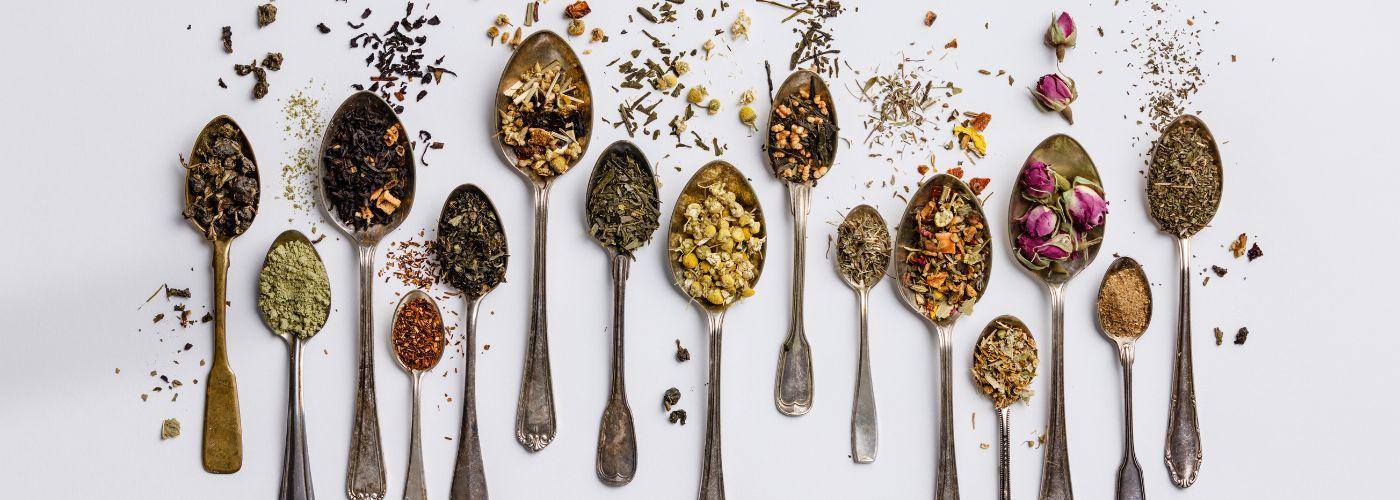
How many grams in a tea spoon of tea Spoon vs Tea-tea measurement-how many tea spoon in table spoon- tea spoon is how many ml- how many tea spoon in a cup- how much is a tea spoon in ml- tea spoon for tea-tea spoon for loose tea- loose tea scoop- perfect tea spoon- perfect teaspoon

Why Teaspoons Aren’t a Standard Measurement

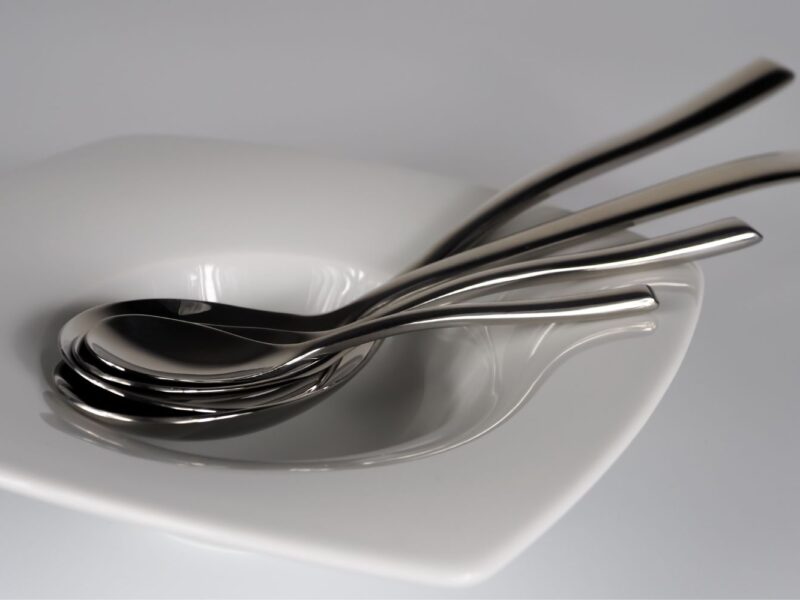
A teaspoon sounds like a fixed unit, but it genuinely isn’t, especially once you step outside a proper set of measuring spoons.

The modern metric teaspoon used in most UK recipes holds 5ml. The traditional UK imperial teaspoon, still referenced in older recipes, was closer to 5.9ml, around 20 percent larger.

The everyday cutlery teaspoon sitting in your drawer at home can vary even more than that, since it was never designed as a measuring tool in the first place.

This matters more than it sounds.

How many grams in a tea spoon of tea Spoon vs Tea-tea measurement-how many tea spoon in table spoon- tea spoon is how many ml- how many tea spoon in a cup- how much is a tea spoon in ml- tea spoon for tea-tea spoon for loose tea- loose tea scoop- perfect tea spoon- perfect teaspoon

A 20 percent difference in spoon volume translates directly into a 20 percent difference in how much tea you’re adding, before the tea itself is even part of the equation.

If you want genuinely consistent results, a proper 5ml measuring spoon, or better still a kitchen scale, removes this variable entirely.

Why Tea Leaf Shape and Density Change the Weight

Even with an identical, properly calibrated spoon, different teas will never weigh the same.

This comes down to how the leaf is processed and shaped, which determines how much empty air sits between the pieces of tea in your spoon.

Leaf Type Why It Weighs What It Weighs
Broken leaf and dust Commonly found in tea bags and some black teas. Packs tightly into a spoon with very little air, making it noticeably heavier per teaspoon.
Whole leaf tea Leaves far more air between the pieces, so the same spoon holds fewer actual grams of tea.
Tightly rolled leaf Such as rolled oolong pellets or gunpowder green tea. Dense and heavy for its size, similar to broken leaf.
Fluffy, airy leaf Such as white tea buds or some delicate green teas. Light and takes up a lot of visual space for very little actual weight.
Fine powder Such as matcha. Behaves differently again, compacting densely into a spoon with almost no air pockets at all.
Herbal and fruit blends The least predictable of all, since dried fruit pieces, petals and larger botanical ingredients vary enormously in size and weight within the same blend.

Grams Per Teaspoon by Tea Type

These figures are reasonable, commonly cited averages rather than exact figures, since even two batches of the same tea type can vary.

Use them as a starting point, then adjust to taste.

Tea Type Grams per Level Teaspoon Why
Black tea, broken leaf or CTC ~3g Small, dense particles pack tightly with little air
Black tea, whole leaf ~2 to 2.5g Larger pieces leave more air gaps in the spoon
Green tea, standard leaf ~1.5 to 2g Lighter, more delicate leaf structure
White tea, buds and fluffy leaf ~1 to 1.5g Very light and airy, minimally processed
Oolong, tightly rolled pellets ~3 to 4g Dense rolled balls with very little airspace
Oolong, twisted leaf ~2g More air between the twisted strands
Herbal blends (petals, leaves, flowers) ~1.5 to 3g Light botanical pieces with variable air gaps, similar to loose leaf
Fruit blends (dried fruit, peel pieces) ~3 to 5g Dense, chunky pieces with little air, weighing heavier per spoon
Matcha, fine powder ~2 to 3g Fine powder compacts densely with almost no air pockets

A Real-World Herbal Tea Experiment

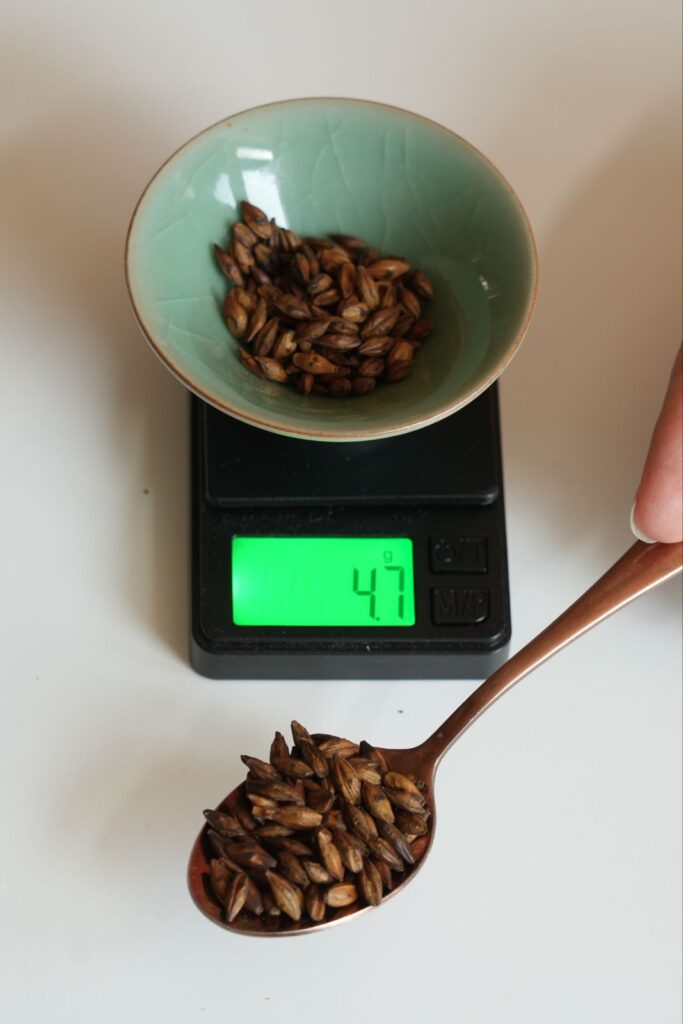
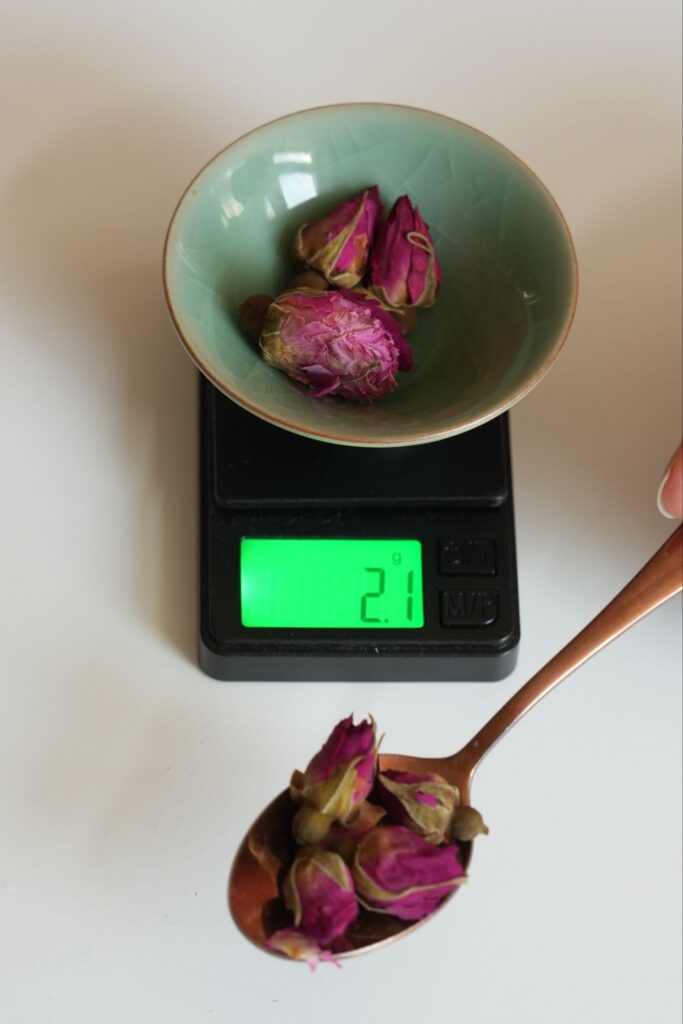
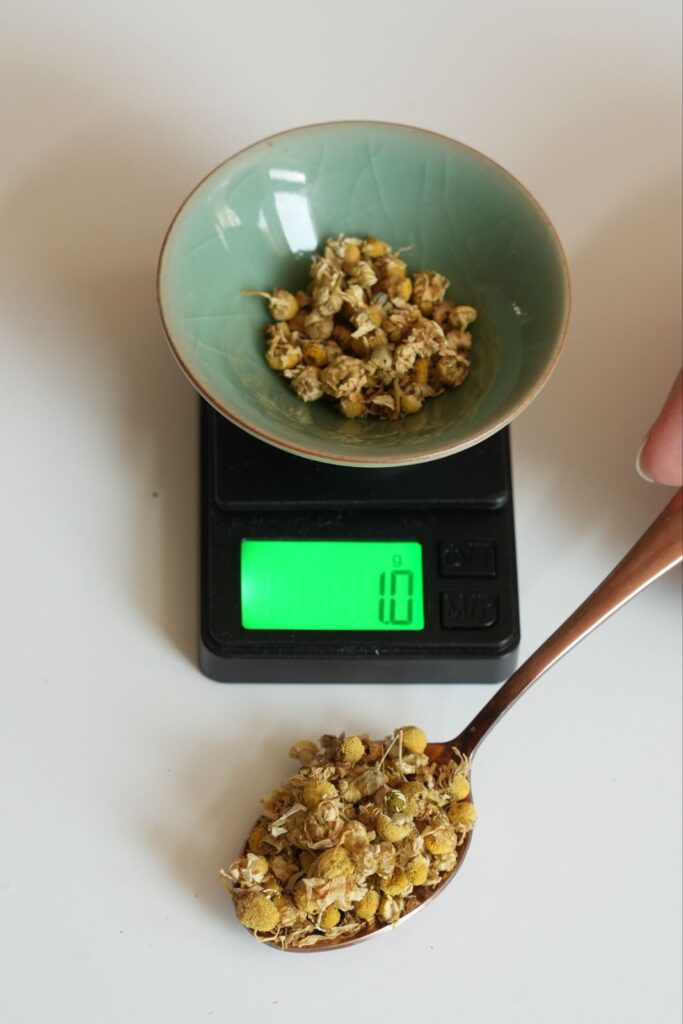
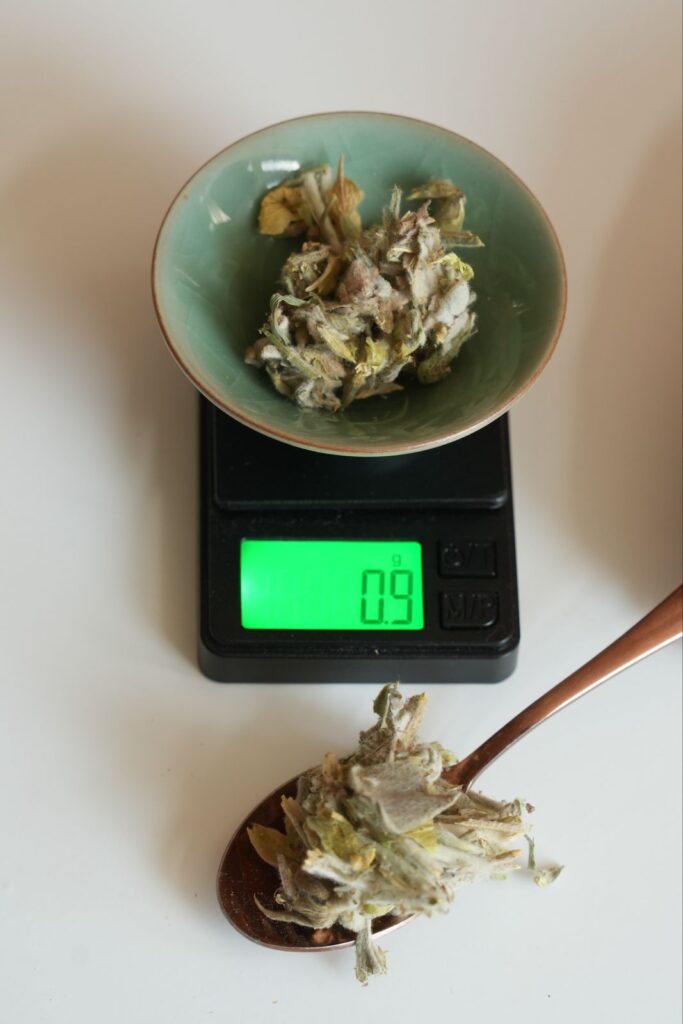
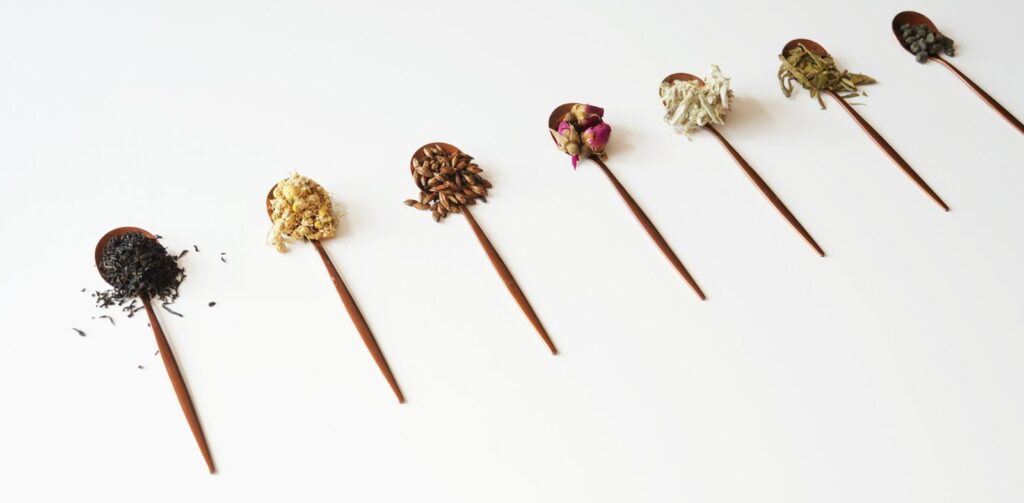
To show just how much herbal blends can vary, we weighed a level teaspoon of four different herbal teas on a digital scale.

Herbal Tea Grams per Level Teaspoon Why
Barley tea ~4.7g Whole roasted grains are dense and pack tightly with very little air
Rose bud tea ~2.1g Whole dried buds hold their shape, leaving moderate air gaps in the spoon
Chamomile ~1.0g Light, papery flower heads take up space without adding much weight
Greek mountain tea ~0.9g Fine, fuzzy stems and flowers are airy and minimally compact

The spread here, from 0.9g to 4.7g in the same teaspoon, is over five times the difference, which is far wider than the variation you’ll see across black, green or oolong tea.

It’s a good illustration of why “one teaspoon” means very different things depending on what’s actually in the spoon.

Barley tea

Rose bud tea

Chamomile

Greek mountain

The Ratio That Actually Matters

Because spoon measurements are so inconsistent, the tea industry generally works in a different unit altogether: grams of tea per volume of water, not teaspoons per cup.

The most widely used western-style brewing standard is roughly 2 to 3 grams of tea per 200 to 240ml (about 8 fluid ounces) of water.

Once you know this ratio, the spoon becomes far less important, it’s simply a rough tool for getting there, not the actual target.

Weighing your tea on a small kitchen scale, even a cheap one, is the only way to hit this ratio precisely and repeat it every time, regardless of which tea or which spoon you’re reaching for.

How to Measure Tea Without a Scale

Tip Detail
Use a proper 5ml measuring spoon Rather than a random cutlery teaspoon, since cutlery spoons vary far more in size.
Always use a level spoon Rather than a heaped one, unless a recipe specifically says otherwise. A heaped teaspoon can hold noticeably more tea than a level one, especially with fine or powdered tea.
Dense, rolled or broken leaf tea Start slightly under a full teaspoon per cup and adjust upward to taste.
Light, fluffy or whole leaf tea You may need slightly more than a level teaspoon to reach the same strength.
Check the packaging first If a tea seller lists a recommended gram weight, trust that over any spoon measurement, since they've usually already weighed it for that specific batch.

Frequently Asked Questions

Most loose leaf tea works out to somewhere between 1.5 and 4 grams per level teaspoon, with 2 grams often used as a general estimate. The exact figure depends on both the tea type and the size of the spoon used.

For everyday cooking purposes, both are treated as 5ml. Historically, the UK imperial teaspoon was slightly larger at around 5.9ml, but modern UK recipes generally use the same 5ml metric standard as elsewhere.

This is almost always down to inconsistent spoon measuring rather than the tea itself, different spoons, heaped versus level scoops, and natural variation in leaf density can all change how much tea actually ends up in your cup.

If consistency matters to you, yes. A small kitchen scale removes both major sources of variation, spoon size and leaf density, and lets you hit the same 2 to 3 grams per 200 to 240ml ratio every time.

As a general starting point, aim for roughly 2 to 3 grams of loose leaf tea per 200 to 240ml of water, then adjust the amount to suit your personal taste and the specific tea you’re brewing.

Keep Learning

Measuring tea accurately is just one part of brewing it well.

For step-by-step instructions on ideal water temperatures, steep times, and precise loose leaf measurements (roughly 2g to 3g per cup) for every tea variety, explore our Tea Brewing Guide.

Teapro co-founder. Favourite tea - Long Jing Dragon Well Green Tea. Obsessed with film, photography and travelling.

No Comments

Post A Comment