24 Aug Tea vs Coffee Acidity: Which Is Gentler on Acid Reflux?
If you have ever swapped your morning coffee for a cup of tea and wondered whether it actually makes a difference to your stomach, you are not alone.
Tea acidity is one of the most searched questions in the tea world, and for good reason. Tea is acidic, just like coffee, but the two drinks are not identical, and the type of tea you choose changes the picture considerably.
In this guide, we walk through the actual pH of black tea, how it compares with coffee, what causes acid in tea in the first place, and whether black tea reflux is something to be genuinely concerned about.
For the full picture of tea types, origins and brewing, see our complete guide to the world of tea, which this article builds on.
Content overview
Is Tea an Acid or a Base?
On the pH scale, which runs from 0 to 14, anything below 7 is acidic and anything above 7 is a base, or alkaline. A pH of exactly 7 is neutral.
So is tea an acid or a base? Brewed tea, whether black, green or oolong, sits below 7, which makes it an acid rather than a base. You may see this searched as is tea a acid or base, tea acid or base, or tea is acid or base.
They are all asking the same thing, and the answer is the same: tea is mildly acidic, not alkaline.
This surprises some people, because green tea in particular has a reputation for being alkaline. That reputation is not accurate.
While green tea is far gentler than black tea or coffee, it is still on the acidic side of the scale, simply much closer to neutral.
Is Tea Acidic or Alkaline?
Tea is acidic, not alkaline, though how acidic it is depends heavily on the type.
If you have searched is tea acidic or alkaline, is tea alkaline or acidic, tea acidic or basic, or is tea basic or acidic, the short version is this: black tea is mildly acidic, oolong sits in the middle, and green and herbal teas are the closest to neutral.
How acidic is tea overall, compared with other everyday drinks? Far gentler than fruit juice or cola, and broadly similar to coffee once you are looking specifically at black tea.
Acidic teas do exist at the more concentrated end, but the acidity tea drinkers experience day to day is mild rather than harsh.
What Is the pH of Black Tea?
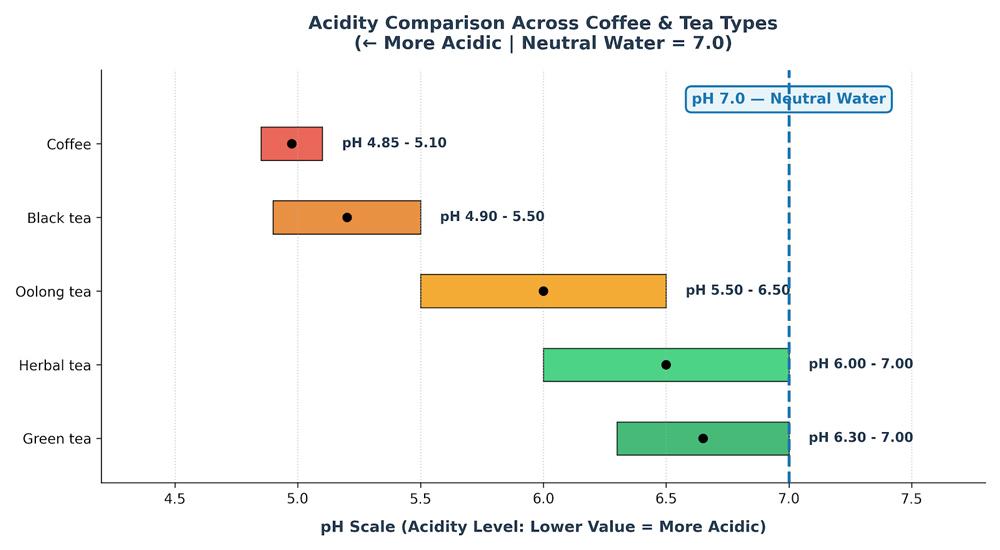
The pH of black tea typically falls between 4.9 and 5.5, depending on the tea, the water used, and how long it is brewed.
Black tea ph sits close to coffee, which averages around 4.85 to 5.1, so the two are often described as neck and neck rather than one being dramatically gentler than the other.
Is black tea acidic? Yes, black tea acidity comes mainly from tannins, specifically compounds called theaflavins and thearubigins, which form during the oxidation process that turns green leaf into black tea.
This is also why black tea acidic notes taste different from the brighter, sharper acid in coffee, even though the pH numbers land in a similar range.
Here is how black tea compares with coffee and other tea types at a glance.
Because the pH scale is logarithmic, every full point drop on the scale represents a 10-fold increase in acidity. A cup of coffee with a pH near 5.0 is approximately 100 times more acidic than pure water (pH 7.0), whereas green tea sits right on the edge of neutral.
| Beverage | Typical pH Range | Acidity Relative to Neutral (pH 7.0) | Classification |
|---|---|---|---|
| Coffee | 4.85 – 5.10 | ~100× more acidic | Mildly acidic |
| Black Tea | 4.90 – 5.50 | ~60× more acidic | Mildly acidic |
| Oolong Tea | 5.50 – 6.50 | ~10× more acidic | Moderately mild |
| Herbal Tea | 6.00 – 7.00 | ~3× more acidic | Near neutral |
| Green Tea | 6.30 – 7.00 | ~2× more acidic | Near neutral |
Tea vs Coffee Acidity: Which Is More Acidic?
| Question | Answer |
|---|---|
| Which is more acidic, coffee or tea? | For black tea specifically, the honest answer is that it is close to a tie. Coffee sits around pH 4.85 to 5.1, and black tea around pH 4.9 to 5.5, so neither is meaningfully gentler on paper. If you are asking which is more acidic tea or coffee expecting a clear winner, the more useful answer depends on the tea type rather than tea as a single category. |
| Is tea less acidic than coffee? | Once you move beyond black tea, yes, noticeably. Green tea and herbal teas sit much closer to neutral, which is why many people find swapping to these gentler options a more comfortable change than swapping to black tea alone. |
| Is tea acidic like coffee across the board? | Not quite. Black tea, yes, broadly. Green and herbal tea, no, they are considerably gentler. |
| Is black tea less acidic than coffee? | Slightly, on average, but the ranges overlap enough that a strong pot of black tea and a mild coffee can land in a similar place. If acidity is your main concern, the tea type matters more than the tea versus coffee question alone. |
Does Tea Have Acid in It?
Does tea have acid in it, or do tea have acid in it, however you phrase the search, the answer is yes.
All true teas, black, green, white, oolong and pu-erh, come from the same Camellia sinensis plant and naturally contain organic acids and tannins.
The acid in black tea is more pronounced than in green tea because oxidation concentrates those compounds further.
Herbal teas and tisanes, such as chamomile, rooibos and peppermint, are not made from Camellia sinensis at all, so they contain a different, generally milder acid profile, which is part of why they read as gentler on a sensitive stomach.
Does Black Tea Trigger Acid Reflux?
Black tea and acidity are closely linked, and for some people with sensitive digestion, black tea reflux is a genuine experience worth paying attention to.
Acid reflux is triggered by a combination of factors, including caffeine content, overall acidity, portion size and individual sensitivity, not pH alone.
Black tea contains both caffeine and mild acidity, which is why some people notice symptoms after a strong cup, particularly on an empty stomach.
This is general information rather than medical advice, and acid reflux can have several underlying causes.
If you experience frequent or persistent heartburn or reflux, it is worth speaking with a doctor or pharmacist rather than adjusting your diet alone.
Tips for a Gentler Cup if You Are Sensitive to Acidity
If tea acidity is something you would rather manage than avoid altogether, a few simple changes can help:
| Tip | Why It Helps |
|---|---|
| Choose green or herbal tea | Both sit much closer to neutral on the pH scale than black tea. |
| Add a splash of milk | Milk can help neutralise some of the acidity in black tea. |
| Brew for less time | Shorter steeping extracts fewer of the acidic compounds. |
| Avoid an empty stomach | Drinking tea on a completely empty stomach can make reflux worse if you are prone to it. |
| Try caffeine-free herbal teas | Chamomile or rooibos in the evening or after meals is a gentler option on digestion. |
For more on black tea specifically, including how it is processed and why it tastes the way it does, read our complete guide to black tea.
Frequently Asked Questions
Tea is an acid. Brewed tea sits below pH 7 on the pH scale, which makes it acidic rather than alkaline, whether it is written as is tea an acid or a base, tea is acid or base, or is tea a acid or base.
Tea is acidic, not alkaline. Black tea is mildly acidic at pH 4.9 to 5.5, while green and herbal teas sit closer to neutral, between roughly pH 6 and 7.
Tea is mildly acidic overall. Black tea has a tea pH similar to coffee, while green and herbal teas are far gentler and close to neutral, making them the least acidic teas in most ranges.
Yes. Black tea acidity typically falls between pH 4.9 and 5.5, driven mainly by tannins formed during oxidation.
The pH of black tea usually ranges from 4.9 to 5.5, though this varies slightly with the tea, water and brew time used.
Yes, all true teas contain natural acids and tannins. The acid in black tea is more concentrated than in green tea because of the oxidation process.
It depends on the tea type. Black tea is close to coffee in acidity, while green and herbal teas are noticeably less acidic than coffee.
Coffee and black tea are broadly similar in pH, so neither is a clear winner. Green and herbal teas are less acidic than both.
Slightly, on average, though the typical pH ranges for black tea and coffee overlap, so the difference is small in practice.
It can for some people, since black tea combines mild acidity with caffeine. Reflux triggers vary by individual, so persistent symptoms are worth discussing with a doctor or pharmacist.
The Bottom Line
Tea is acidic, but not uniformly so.
Black tea sits close to coffee on the pH scale, while green and herbal teas are considerably gentler and closer to neutral.
If acid reflux or sensitivity is a concern, the tea type you choose matters more than simply swapping coffee for tea alone.

Teapro co-founder. Favourite tea - Long Jing Dragon Well Green Tea. Obsessed with film, photography and travelling.


No Comments