17 Aug Best Water For Tea: Mastering Water Chemistry for a Superior Brew
Ninety-nine percent of the liquid in your cup is water.
So when a tea you love tastes flat, harsh or strangely different from the last packet, the tea leaf is rarely the problem – the water is.
If you’re serious about tasting the real character of a single-origin leaf rather than a diluted or distorted version of it, understanding basic water chemistry is one of the fastest upgrades you can make to your brewing.
At Teapro, we believe artificial flavourings mask the real taste of tea.
But so does the wrong water.
Unlocking the best water for tea comes down to three key factors: pH, hardness, and total dissolved solids (TDS). This guide breaks down the science in plain English, explaining how tap water affects your leaf and giving you straightforward ways to fix it—no matter where you brew in the UK.
Table of Contents
Why Water Matters More Than You Think
It’s easy to obsess over leaf grade, steep time and water temperature while overlooking the ingredient that makes up almost the entire cup.
Water is not a neutral carrier.
It arrives already loaded with dissolved minerals, gases and a particular pH, and every one of those properties changes how the compounds in tea leaves – catechins, theaflavins, amino acids and volatile aromatics – dissolve and express themselves.
The same leaf, brewed identically in two different waters, can taste bright and complex in one cup and flat, cloudy or bitter in the other.
This is why tea tasted at source, or in a shop with a dedicated water system, so often tastes better than the same tea brewed at home.
The Three Factors: pH, Hardness and TDS
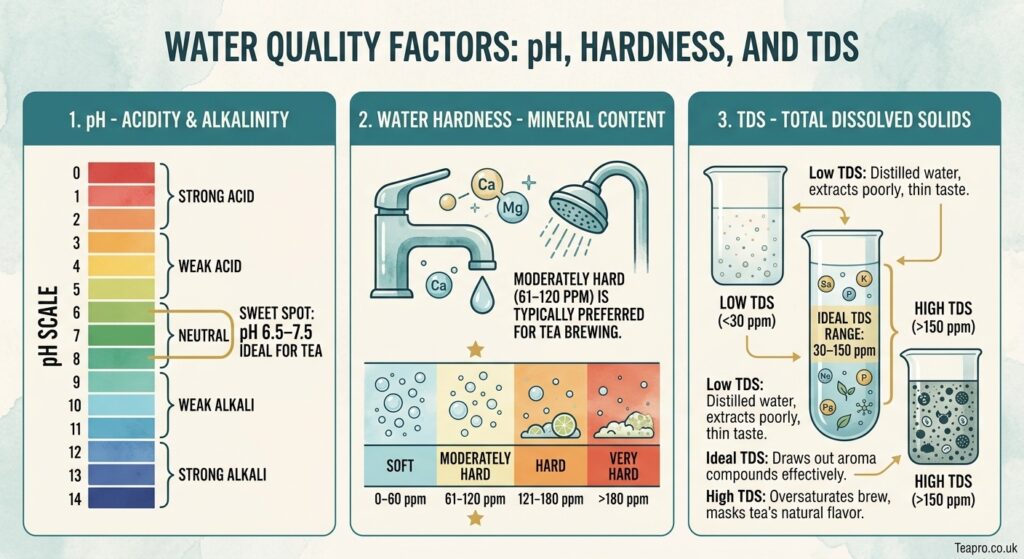
Three measurable properties of water do almost all of the work in determining the best water for tea: pH, hardness, and total dissolved solids.
Understanding each one helps you diagnose exactly what’s going wrong in your cup.
pH: acidity and alkalinity
pH measures how acidic or alkaline your water is, on a scale of 1 to 14, with 7 as neutral.
Tea prefers water close to neutral, ideally between 6.5 and 7.5.
Water that’s too alkaline tends to dull brightness and push flavours towards flat or soapy; water that’s too acidic can accentuate sourness and thin out body.
Brewed tea itself typically settles at a mildly acidic pH once the leaves have infused, so the goal is a neutral starting point that lets the leaf’s own chemistry lead.
Hardness: calcium and magnesium
Hardness refers to the concentration of calcium and magnesium ions in your water, measured in parts per million (ppm) or milligrams per litre.
This is the single biggest factor in UK tea brewing, because hardness varies enormously by region.
A commonly cited sweet spot for tea is roughly 17 to 68 ppm, or 1 to 4 grains of hardness.
Too soft, and water below around 10 ppm can leave tea tasting thin, bitter or overly astringent, with weaker colour.
Too hard, and water above roughly 120 ppm starts to flatten flavour, mute aroma and, especially with iced tea, cause visible clouding and a filmy surface.
Excess calcium in particular binds with the polyphenols in tea, blunting the leaf’s natural character rather than letting it shine.
TDS: total dissolved solids
TDS measures the overall concentration of dissolved minerals and salts in water, again in ppm.
Estimates for the ideal range vary slightly by source, but most sit somewhere between 30 and 150 ppm for loose leaf tea.
Water with almost no TDS, such as distilled or heavily purified water, tends to extract flavour poorly and taste thin, because there are no minerals present to help draw out and carry aroma compounds.
Water with very high TDS oversaturates the brew, leaving no room for the tea’s own flavour to register.
Is UK Tap Water Good for Tea?
The honest answer is: it depends entirely on your postcode.
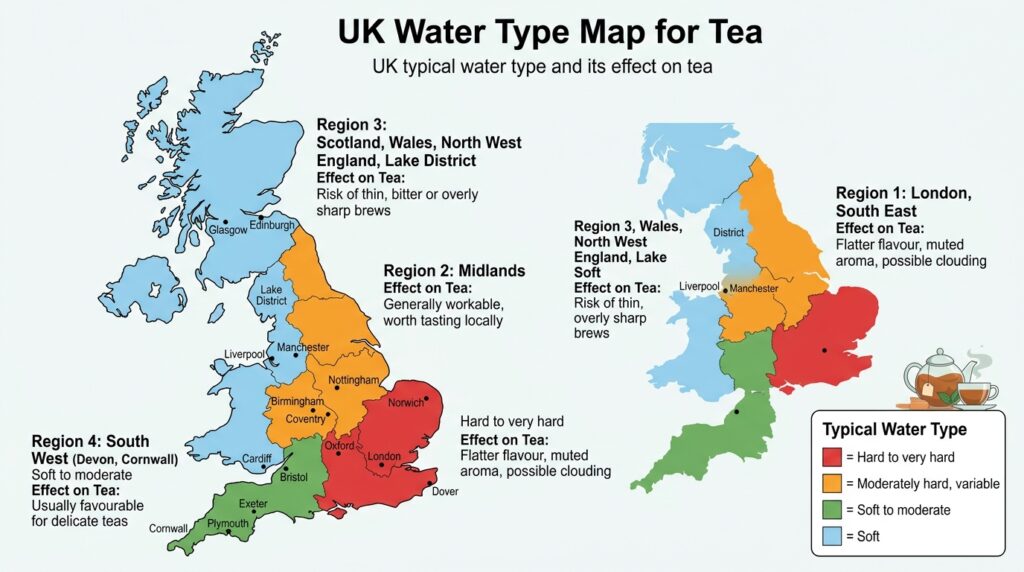
UK water hardness varies dramatically by region because it’s shaped by the geology the water has travelled through before reaching your tap.
London, the South East, and much of eastern England sit on chalk and limestone, which means water absorbs high levels of calcium and magnesium on its way to you – this is classic hard, sometimes very hard, water territory.
Scotland, Wales, the Lake District and much of North West England sit on older granite and igneous rock, which barely dissolves, producing naturally soft water with low mineral content.
| UK Region | Typical Water Type | Effect on Tea |
|---|---|---|
| London, South East, Anglian region | Hard to very hard | Flatter flavour, muted aroma, possible clouding |
| Midlands | Moderately hard, variable | Generally workable, worth tasting locally |
| Scotland, Wales, North West England, Lake District | Soft | Risk of thin, bitter or overly sharp brews |
| South West (Devon, Cornwall) | Soft to moderate | Usually favourable for delicate teas |
If you’re regularly seeing limescale on your kettle, or your tea tastes noticeably better away from home, hardness is very likely part of the story.
Your local water company’s website will usually let you check hardness levels by postcode.
Matching Water to Tea Type
Different tea types respond differently to water chemistry, largely because of how delicate or robust their flavour compounds are.
| Tea Type | Water Sensitivity |
|---|---|
| Green and white teas | Most sensitive to hardness and chlorine. Soft, low-TDS, neutral-pH water preserves the delicate vegetal and floral notes that hard water tends to flatten. |
| Oolong teas | Benefit from water on the softer side of moderate. Excess calcium has been shown to reduce desirable taste notes and increase astringency in oolong specifically. |
| Black and chai blends | More forgiving of moderate hardness, and a touch of mineral content can support body, but very hard water will still dull the malty, brisk character these teas are prized for. |
| Pu-erh and other aged, fermented teas | Reasonably robust, but very hard water can still mute the earthy depth that makes these teas distinctive. |
| Herbal blends | Less sensitive overall, though chlorine taste and odour from unfiltered tap water can still interfere with delicate botanicals. |
How to Improve Your Water at Home
You don’t need a laboratory to brew consistently better tea.
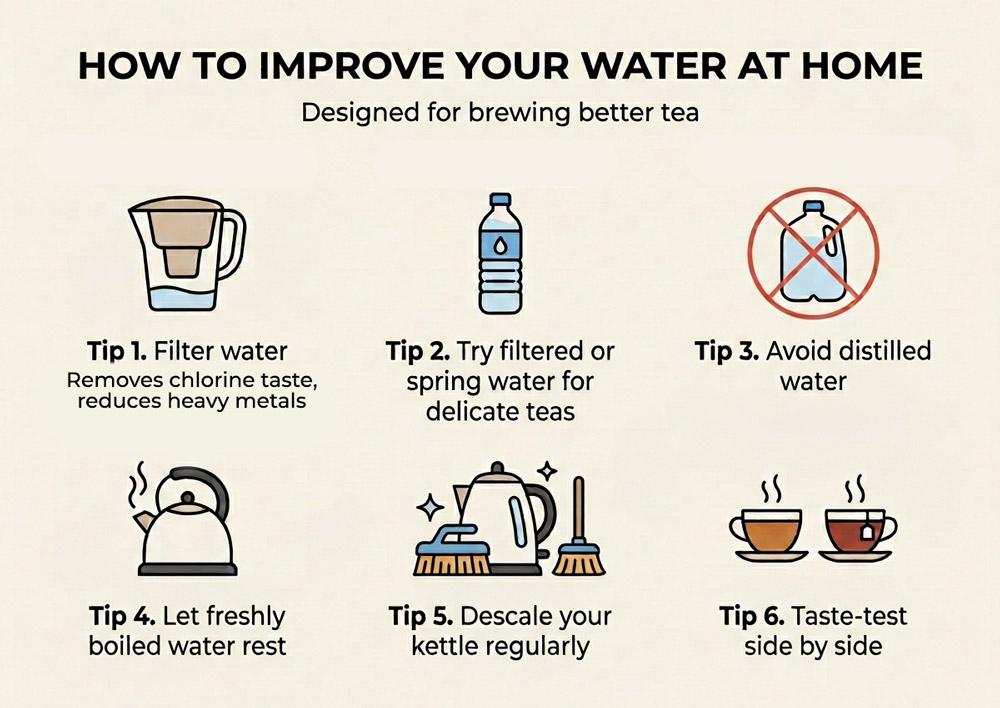
A few practical adjustments cover most UK households:
| Tip | Details |
|---|---|
| Filter your water | A basic jug filter removes chlorine taste and some hardness, which is often enough to noticeably improve green and white teas. |
| Try filtered or spring water for delicate teas | If your tap water is very hard or very soft, a neutral-mineral bottled spring water is a simple way to taste what your tea is capable of. |
| Avoid distilled or heavily purified water | It strips out the minerals tea needs to extract flavour properly, leaving cups tasting hollow. |
| Let freshly boiled water rest briefly for delicate teas | This helps drive off chlorine odours and brings the temperature into the right range for green and white teas. |
| Descale your kettle regularly if you're in a hard water area | Scale build-up affects heating efficiency and can transfer a faint mineral taste into your brew. |
| Taste-test side by side | The most reliable way to judge water for your favourite tea is a direct comparison: the same leaf, same temperature, same steep time, two different waters. |
Frequently Asked Questions
Most tea professionals point to moderately soft, low-to-medium TDS water with a near-neutral pH as the best starting point, roughly 30 to 150 ppm TDS and a pH close to 7. Filtered tap water or a neutral spring water usually gets you into this range.
It won’t ruin it outright, but very hard water – typically above around 120 ppm hardness – commonly flattens flavour, mutes aroma and can cloud iced tea. Delicate green, white and oolong teas show this most clearly.
Either can work well. A basic jug or tap filter removes chlorine and some hardness at low cost, while neutral-mineral spring water is a convenient option if your local tap water is at either extreme.
Not usually. Distilled and heavily purified water lack the minerals that help extract and carry flavour, which tends to leave tea tasting thin and one-dimensional.
This is very often down to water rather than the tea itself. Different local water supplies, or a shop’s dedicated filtration system, can produce a noticeably different cup from the same leaf.
Keep Learning
Water is just one part of brewing tea well.
For the full picture, loose leaf selection, water temperature, steep time, and technique, read our complete tea brewing guide.
explore our related articles

Teapro co-founder. Favourite tea - Long Jing Dragon Well Green Tea. Obsessed with film, photography and travelling.


No Comments